
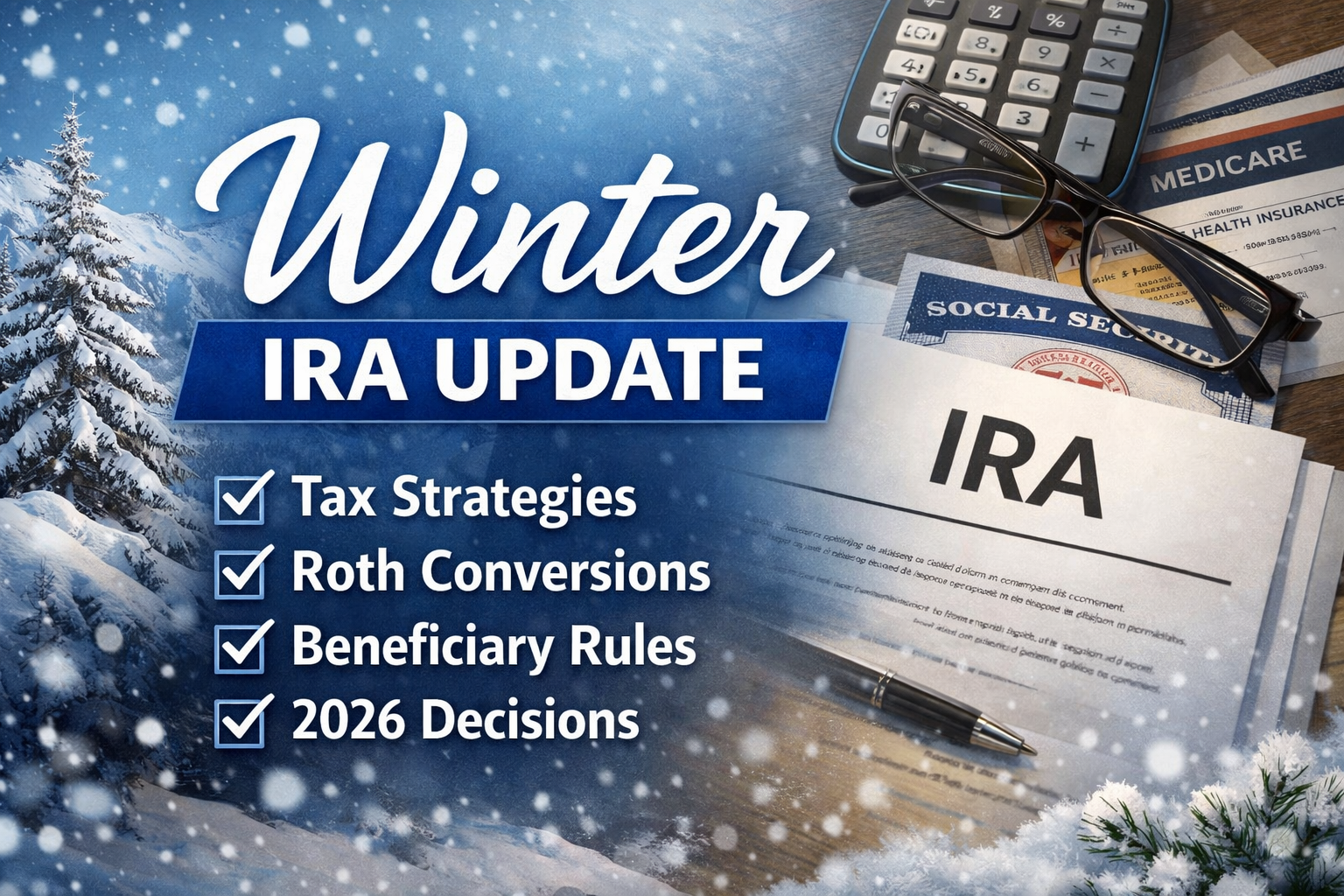
2026 Retirement Planning Update: Taxes, IRAs, and Smart Next Steps
Why This Update Matters
In this Winter Update, Chris Cordoba (Founder, CFP®) shares key insights from the latest Ed Slott Elite IRA Advisor Group conference — along with the tax changes, planning updates, and retirement risks our team is actively monitoring on your behalf.
Our goal is simple: stay ahead of rule changes, identify planning opportunities early, and make sure your retirement strategy continues to work efficiently as laws and circumstances evolve.
This recap highlights the most important themes from the session if you prefer to read instead of watching the full replay.
This content is for educational purposes only and should not be considered tax, legal, or investment advice. Your situation is unique — please consult your advisory team before making any changes.
The Biggest Retirement Risks Aren’t Investment Risks
Most retirement plans don’t break down because of market performance.
They break down when financial decisions happen in isolation.
Income timing, tax brackets, Medicare premiums, required distributions, beneficiary rules, and estate structures all interact. When those decisions aren’t coordinated, families often make reasonable choices that quietly increase taxes, reduce flexibility, or create unnecessary complexity later.
The focus of this update is coordination — making sure the pieces continue working together over time.
Why Retirement Accounts Require Special Attention
Retirement accounts follow different rules than other assets, and those differences matter more as balances grow.
Key distinctions include:
- Withdrawals are generally taxed as ordinary income
- Retirement accounts do not receive a step-up in basis at death
- Beneficiary designations often control the outcome — not your will or trust
- Required distribution rules can force income timing whether you want it or not
Because of these rules, small planning decisions around IRAs can have long-term tax consequences if they aren’t managed carefully.
Tax Preparation Files the Past. Tax Planning Protects the Future.
One of the core themes from the conference was the difference between two very different activities:
Tax preparation looks backward — filing last year’s return.
Tax planning looks forward — managing income over time to reduce your lifetime tax burden.
For many households, the opportunity isn’t finding deductions.
It’s coordinating withdrawals, Roth conversions, Medicare thresholds, and estate strategy so taxes are paid intentionally — not reactively.
The OBBBA Changes: Why the Opportunity Is Time
The One Big Beautiful Bill Act (OBBBA) includes several tax-related changes. While it does not directly rewrite IRA rules like the SECURE Acts did, it still affects retirement planning because tax brackets influence withdrawal and conversion decisions.
The most important takeaway isn’t any single provision.
It’s that the current environment may provide more planning runway — more time to make strategic decisions before future changes or required distributions limit your flexibility.
Don’t Let Small Year-to-Year Decisions Override Long-Term Strategy
Some new deductions and adjustments may provide modest short-term tax benefits.
However, focusing only on this year’s savings can sometimes work against a longer-term strategy — particularly when evaluating:
- Roth conversions
- Larger IRA withdrawals
- Timing of major expenses
- Coordination across multiple income sources
The more important question is rarely “What saves the most this year?”
It’s “What keeps lifetime taxes lower and options more flexible?”
Medicare IRMAA: A Threshold Worth Managing Intentionally
Income levels can affect Medicare Part B and Part D premiums through IRMAA surcharges.
In some cases, temporarily crossing a threshold may make sense if it supports a broader tax strategy.
But what you want to avoid is crossing a threshold unintentionally — for example, by stacking income events in the same year or taking additional IRA withdrawals without planning.
Managing income timing helps prevent paying more than necessary for the entire year.
Inherited IRA Rules Have Changed the Legacy Conversation
Under the SECURE rules, most non-spouse beneficiaries must withdraw inherited retirement accounts within a limited timeframe.
This means retirement accounts are no longer the long-term “stretch” inheritance tool they once were.
As a result, it’s important to periodically review:
- Primary and contingent beneficiaries
- Whether a trust still aligns with current rules and your intent
- The broader strategy for how retirement assets pass to the next generation
Older assumptions about how IRAs transfer may no longer apply.
Planning for the Surviving Spouse Window
One of the most important planning periods occurs during the year a spouse passes away.
That year may be the last opportunity to file a joint tax return, which often provides more favorable brackets than future single-filer years.
Having this strategy discussed in advance helps avoid rushed decisions during an already difficult time and ensures opportunities aren’t missed.
When Trusts and Retirement Accounts Need a Second Look
Trusts can be the right solution in certain situations, including special needs planning or when control and protection are priorities.
However, retirement accounts held for the benefit of a trust may face compressed tax brackets and distribution rules if the structure isn’t aligned with current law.
If your estate plan includes a trust created years ago, it may be worth reviewing to confirm it still accomplishes your goals efficiently.
What We’re Watching: Early Savings Accounts for Children
The session also discussed a developing concept sometimes referred to as “Trump Accounts,” intended as early-start savings vehicles for children born within certain years.
Details are still evolving, but the broader planning principle remains important: when saving begins early and is structured properly, even modest contributions can create meaningful flexibility later.
If you have children or grandchildren born in 2025 or 2026, we’re monitoring developments and will share updates as guidance becomes final.
Most Missed Opportunities Happen During Life Transitions
The highest-risk planning gaps typically occur during major changes, such as:
- Retirement or early retirement decisions
- Job changes or layoffs
- Loss of a spouse or partner
- Inheritances
- Milestone ages (Medicare eligibility, RMD start age, charitable distribution opportunities)
Early coordination during these transitions helps preserve flexibility and avoid unnecessary taxes.
What This Means for You
If you’re a CRA client, there’s nothing you need to manage on your own.
Our team is already:
- Monitoring tax law changes and planning opportunities
- Reviewing IRA distribution and Roth conversion strategies
- Watching Medicare thresholds and potential income impacts
- Coordinating with your tax and estate professionals when appropriate
If any of the items discussed in this update create a planning opportunity for your situation, we’ll address it with you as part of your ongoing review process.
Your role is simple: enjoy retirement — and focus on living the life you CRAve.
If you experience a major life event (retirement, job change, inheritance, loss of a spouse, etc.), just let your advisory team know so we can adjust the plan as needed.
Need to Talk?
If you’re not currently working with California Retirement Advisors and would like a second opinion, we’re happy to start with a brief 20-minute conversation to understand your situation and see if we can help.
Disclosure
Investment advisory services offered through Mutual Advisors, LLC DBA California Retirement Advisors, a SEC registered investment advisor. Securities offered through Mutual Securities, Inc., member FINRA/SIPC. Mutual Securities, Inc. and Mutual Advisors, LLC are affiliated companies. CA Insurance license #0B09076. This content is developed from sources believed to be providing accurate information and provided by California Retirement Advisors. It may not be used for the purpose of avoiding any federal tax penalties. Please consult legal or tax professionals for specific information regarding your individual situation. The opinions expressed and material provided are for general information and should not be considered a solicitation for the purchase or sale of any security. California Retirement Advisors, nor any of its members, are tax accountants or legal attorneys and do not provide tax or legal advice. For tax or legal advice, you should consult your tax or legal professional.The information being provided is strictly as a courtesy. When you click on any of the links provided here, you are leaving this website and viewing information provided by a third party. We make no representation as to the completeness or accuracy of information provided by any third-party website. Nor is the company liable for any direct or indirect technical or system issues or any consequences arising out of your access to, or your use of third-party technologies, websites, information and programs made available through this website. By accessing these calculators, you assume total responsibility and risk for your use of the third-party website.