
facebook twitter instagram linkedin google youtube vimeo tumblr yelp rss email podcast phone blog search brokercheck brokercheck Play Pause
Health Care Costs Are on Everyone's Minds Thumbnail

Health Care Costs Are on Everyone's Minds

The Markets

Last week, the United States Federal Reserve (Fed) played “Would You Rather?”

Would You Rather? is a board game that presents players with classic dilemmas and asks which options would be more palatable to them. For example, a game card might ask, Would you rather:

  • Be able to run on your hands or write with your feet? 
  • Eat chocolate-flavored broccoli or broccoli-flavored chocolate?
  • Have the ability to see 10 minutes into the future or 150 years into the future?

Broadly speaking, the Fed has two mandates: 1) support maximum employment, and 2) support stable prices. Last week, members of the Fed’s Federal Open Market Committee (FOMC) were asked to decide whether a cooling labor market or elevated inflation presented the bigger risk to the American people. 

If elevated inflation were the bigger risk, the federal funds rate might remain unchanged or move higher to support lower prices.

If cooling employment were the bigger risk, the federal funds rate might remain unchanged or move lower to support maximum employment.

FOMC members were asked to make the decision without access to economic data from October and November, which are expected to be released in mid-December, according to Megan Leonhardt of Barron’s. 

The FOMC decided to lower the federal funds rate by a quarter of a percentage point. However, there was significant disagreement within the Fed about whether that was the right course of action. Two committee members thought the federal funds rate should remain unchanged, and one thought the rate cut should have been larger, reported Catarina Saraiva of Bloomberg. 

In addition, the Fed’s quarterly rate projections showed that six policymakers who are not on the FOMC indicated “the benchmark federal funds rate should end 2025 in a range of 3.75 [percent] to 4 [percent] — where it stood before Wednesday’s cut — suggesting they opposed the move,” reported Saraiva.

Since September 2025, the FOMC has lowered the federal funds rate by 0.75 percent. Since September 2024, it has lowered the rate by 1.75 percent.

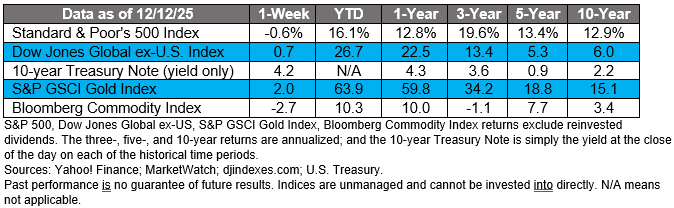
The Standard & Poor’s 500 and Nasdaq Composite Indexes finished the week lower after a broad selloff on Friday that Karishma Vanjani of Barron’s attributed to uncertainty about artificial intelligence. The Dow Jones Industrial Average gained over the week. Yields on long maturities of U.S. Treasuries remained steady or moved higher over the week.


Health Care Costs Are on Everyone's Minds

The cost of employer health benefits is rising faster than inflation and wages, reported Mercer’s Tracy Watts and Beth Umland. According to the Bureau of Labor Statistics, year over year through September 2025: 

  • Employers’ health insurance costs increased 6.1 percent,
  • Wages and salaries rose 3.5 percent, and 
  • Inflation was up 2.8 percent.

Mercer’s National Survey of Employer-Sponsored Health Plans found the average cost of employer-sponsored health insurance reached $17,496 per employee in 2025, and is expected to increase another 6.7 percent in 2026, which would bring the average cost above $18,500 per employee.

“In nearly all employer-sponsored health plans, cost is shared with employees through both premium contributions deducted from their paychecks and plan design features that shift some financial responsibility to plan members when they access care. Since employees’ share of the cost of health coverage typically rises at about the same rate as overall cost, increases of this magnitude are heightening concerns about healthcare affordability,” wrote Watts and Umland.

A Kaiser Family Foundation poll conducted last summer confirmed that many Americans struggle with the cost of health care. It found that:

  • 42 percent of insured Americans, ages 18 to 64, said it was somewhat or very difficult to pay for health care. 
  • 82 percent of uninsured Americans, ages 18 to 64, said it was somewhat or very difficult to pay for health care. 

“Medical expenses are the leading cause of personal bankruptcy in the United States… Unexpected or chronic medical conditions can quickly overwhelm financial resources, even for those with health insurance. Given that over 90 [percent] of Americans have health insurance through commercial or government programs, the prevalence of medical bankruptcy is disconcerting,” reported Jay Eisenstock in Chief Healthcare Executive magazine.

If you have questions about health insurance, get in touch. We may be able to provide some answers.


Weekly Inspiration

“Our two goals are a bit in tension…everyone around the table at the FOMC agrees that inflation is too high and we want it to come down, and agrees that the labor market has softened and there is risk on that… the difference is how you weight those risks and what does your forecast look like – where do you think the bigger risk is. It’s very unusual to have persistent tension between the two parts of the mandate…You’ve got one tool. You can’t do two things at once.”

--Federal Reserve Chair Jerome Powell, December 10, 2025

Best Regards,
California Retirement Advisors


Investment advisory services offered through Mutual Advisors, LLC DBA California Retirement Advisors, a SEC registered investment advisor. Securities offered through Mutual Securities, Inc., member FINRA/SIPC. Mutual Securities, Inc. and Mutual Advisors, LLC are affiliated companies. CA Insurance license #0B09076. This content is developed from sources believed to be providing accurate information and provided by California Retirement Advisors. It may not be used for the purpose of avoiding any federal tax penalties. Please consult legal or tax professionals for specific information regarding your individual situation. The opinions expressed and material provided are for general information and should not be considered a solicitation for the purchase or sale of any security. California Retirement Advisors, nor any of its members, are tax accountants or legal attorneys and do not provide tax or legal advice. For tax or legal advice, you should consult your tax or legal professional.
The information being provided is strictly as a courtesy. When you click on any of the links provided here, you are leaving this website and viewing information provided by a third party. We make no representation as to the completeness or accuracy of information provided by any third-party website. Nor is the company liable for any direct or indirect technical or system issues or any consequences arising out of your access to, or your use of third-party technologies, websites, information and programs made available through this website. By accessing these calculators, you assume total responsibility and risk for your use of the third-party website.
* These views are those of Carson Coaching, not the presenting Representative, the Representative’s Broker/Dealer, or Registered Investment Advisor, and should not be construed as investment advice.
* Government bonds and Treasury Bills are guaranteed by the U.S. government as to the timely payment of principal and interest and, if held to maturity, offer a fixed rate of return and fixed principal value.  However, the value of fund shares is not guaranteed and will fluctuate.
* Corporate bonds are considered higher risk than government bonds but normally offer a higher yield and are subject to market, interest rate and credit risk as well as additional risks based on the quality of issuer coupon rate, price, yield, maturity, and redemption features.
* The Standard & Poor's 500 (S&P 500) is an unmanaged group of securities considered to be representative of the stock market in general. You cannot invest directly in this index.
* All indexes referenced are unmanaged. The volatility of indexes could be materially different from that of a client’s portfolio. Unmanaged index returns do not reflect fees, expenses, or sales charges. Index performance is not indicative of the performance of any investment. You cannot invest directly in an index.
* The Dow Jones Global ex-U.S. Index covers approximately 95% of the market capitalization of the 45 developed and emerging countries included in the Index.
* The 10-year Treasury Note represents debt owed by the United States Treasury to the public. Since the U.S. Government is seen as a risk-free borrower, investors use the 10-year Treasury Note as a benchmark for the long-term bond market.
* Gold represents the 3:00 p.m. (London time) gold price as reported by the London Bullion Market Association and is expressed in U.S. Dollars per fine troy ounce. The source for gold data is Federal Reserve Bank of St. Louis (FRED), https://fred.stlouisfed.org/series/GOLDPMGBD228NLBM.
* The Bloomberg Commodity Index is designed to be a highly liquid and diversified benchmark for the commodity futures market. The Index is composed of futures contracts on 19 physical commodities and was launched on July 14, 1998.
* The DJ Equity All REIT Total Return Index measures the total return performance of the equity subcategory of the Real Estate Investment Trust (REIT) industry as calculated by Dow Jones.
* The Dow Jones Industrial Average (DJIA), commonly known as “The Dow,” is an index representing 30 stock of companies maintained and reviewed by the editors of The Wall Street Journal.
* The NASDAQ Composite is an unmanaged index of securities traded on the NASDAQ system.
* International investing involves special risks such as currency fluctuation and political instability and may not be suitable for all investors. These risks are often heightened for investments in emerging markets.
* Yahoo! Finance is the source for any reference to the performance of an index between two specific periods.
* The risk of loss in trading commodities and futures can be substantial. You should therefore carefully consider whether such trading is suitable for you in light of your financial condition. The high degree of leverage is often obtainable in commodity trading and can work against you as well as for you. The use of leverage can lead to large losses as well as gains.
* Opinions expressed are subject to change without notice and are not intended as investment advice or to predict future performance.
* Economic forecasts set forth may not develop as predicted and there can be no guarantee that strategies promoted will be successful.
* Past performance does not guarantee future results. Investing involves risk, including loss of principal.
* The foregoing information has been obtained from sources considered to be reliable, but we do not guarantee it is accurate or complete.
* There is no guarantee a diversified portfolio will enhance overall returns or outperform a non-diversified portfolio. Diversification does not protect against market risk.
* Asset allocation does not ensure a profit or protect against a loss.
* Consult your financial professional before making any investment decision.
Sources: 
https://www.countryliving.com/life/entertainment/a45510378/would-you-rather-questions-for-adults-friends/? [Go to Funny and For Kids]
https://www.federalreserve.gov/newsevents.htm [8:45 and 19:06]
https://www.barrons.com/articles/white-house-inflation-cpi-ecca79df?refsec=federal-reserve&mod=topics_federal-reserve or go to https://resources.carsongroup.com/hubfs/WMC-Source/2025/12-15-25-Barrons-Why-the-White-House%20-%203.pdf
https://www.bloomberg.com/news/articles/2025-12-10/-silent-dissents-reveal-growing-fed-resistance-to-powell-s-cuts?embedded-checkout=true or go to https://resources.carsongroup.com/hubfs/WMC-Source/2025/12-15-25-Bloomberg-Silent-Dissents-Reveal%20-%204.pdf
https://www.newyorkfed.org/markets/reference-rates/effr or go to https://resources.carsongroup.com/hubfs/WMC-Source/2025/12-15-25-Federal-Reserve-Bank-of-New-York%20-%205.pdf
https://www.barrons.com/livecoverage/stock-market-news-today-121225/card/friday-stock-market-selloff-wipes-out-s-p-weekly-gains-nasdaq-drops-1-7--E1Ef8TZjIX9NvMHZAZBO or go to https://resources.carsongroup.com/hubfs/WMC-Source/2025/12-15-25-Barrons-Selloff-Wipes-Out%20-%206.pdf
https://www.barrons.com/market-data?mod=BOL_TOPNAV or go to https://resources.carsongroup.com/hubfs/WMC-Source/2025/12-15-25-DJIA-S&P-Nasdaq%20-%207.pdf
https://home.treasury.gov/resource-center/data-chart-center/interest-rates/TextView?type=daily_treasury_yield_curve&field_tdr_date_value=202512
https://www.mercer.com/en-us/insights/us-health-news/employers-are-challenged-to-keep-healthcare-affordable-as-costs-soar-survey-results/
https://www.bls.gov/news.release/pdf/eci.pdf [Table A]
https://www.bea.gov/sites/default/files/2025-12/pi0925.pdf
https://www.kff.org/health-costs/americans-challenges-with-health-care-costs/ [Figure 1]
https://www.chiefhealthcareexecutive.com/view/the-financial-toll-of-medical-bills-why-healthcare-costs-lead-to-bankruptcy-viewpoint