
facebook twitter instagram linkedin google youtube vimeo tumblr yelp rss email podcast phone blog search brokercheck brokercheck Play Pause
Let's Talk Money! Thumbnail

Let's Talk Money!

The Markets

Investor appetite broadens.

For a long time, investors have craved artificial intelligence (AI) related investments. Early in 2026, that’s begun to change. Paul R. La Monica of Barron’s reported:

“Everywhere you look, stocks of all stripes are hitting new highs. That should be great news for investors as the market broadens out to start 2026…The broadening of the rally is picking up steam. You wouldn’t know it from looking at the major indexes…While the declines were small and the indexes remain near all-time highs, the fact that they are underperforming small-caps, international stocks, and the equal-weighted S&P 500 is another sign that investors are looking beyond the usual suspects for stocks to buy.”

Here’s what we saw last week:

  • Smaller companies taking the lead. The Russell 2000 Index, which tracks the performance of small company stocks, performed better than the Standard & Poor (S&P) 500 Index last week for the 11th trading session in a row, reported Joel Leon of Bloomberg.
  • A Treasury market shake-up. The yield on benchmark 10-year U.S. Treasuries rose to 4.24 percent after President Trump appeared to change his mind about who might replace Federal Reserve Chair Jerome Powell later this year, reported Michael MacKenzie, Elizabeth Stanton, and Alex Harris of Bloomberg.

The current frontrunner for the position is former Fed governor Kevin Warsh, who “has more credibility in the world of central banking and is perceived as someone who will keep the central bank narrowly focused on its mandate, with a willingness to move toward a less dominant central bank footprint in markets.”

  • Good news on prices. The rate of inflation didn’t fall to the Federal Reserve’s target level of two percent in December, but it also didn’t move higher. Prices rose 2.7 percent annualized last month. When volatile food and energy prices were excluded, inflation was 2.6 percent annualized, according to the Consumer Price Index (CPI). 

While inflation overall was steady, prices for housing, groceries, clothes, recreation, and airfare moved higher. These price increases were balanced by price declines for household furnishings, used cars and trucks, and gasoline.

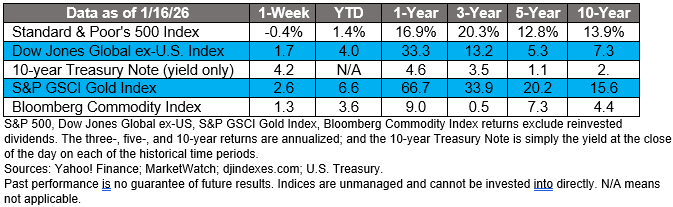
While they remained near all-time highs at the end of last week, the Standard & Poor’s 500 Index, Nasdaq Composite, and Dow Jones Industrial Average finished lower. The yield on the benchmark 10-year U.S. Treasury was higher.


Let's Talk Money!

Everywhere you look, money and economics influence the world. The language of money has its roots in medieval Spanish literature, according to Cornell Professor Simone Pinet. As the merchant economy developed there, the language of money and trade spread throughout society. Over the centuries and around the world, people have coined colorful terms for currency and wealth. See what you know about the language of money by taking this brief quiz.

  1. What is “net worth”?
    1. The amount of money you earn each year
    2. The value of everything you own minus money owed
    3. The amount of cash in your bank account
    4. The amount you can borrow based on your credit score
  1. When a news story says a company is raising “capital”, what is it trying to do?
    1. Raise money to expand its business
    2. Sell stocks to finance new product development
    3. Borrow money to build a new research facility
    4. Any of the above
  1. Which of the following is slang meaning “one dollar”?
    1. Sawbuck
    2. Simoleon
    3. Benjamin
    4. C-note
  1. Which of the following slang terms does NOT imply wealth, refinement, or upper-class status?
    1. Silk stocking
    2. Croesus
    3. Moolah
    4. Plutocrat

Weekly Inspiration

“When you plant lettuce, if it does not grow well, you don't blame the lettuce. You look for reasons it is not doing well. It may need fertilizer, or more water, or less sun. You never blame the lettuce. Yet if we have problems with our friends or family, we blame the other person. But if we know how to take care of them, they will grow well, like the lettuce. Blaming has no positive effect at all, nor does trying to persuade using reason and argument. That is my experience. No blame, no reasoning, no argument, just understanding. If you understand, and you show that you understand, you can love, and the situation will change”

― Thich Nhat Hanh, Author 

Answers:

1) b; 2.) d; 3.) b; 4) c

Best Regards,
California Retirement Advisors


Investment advisory services offered through Mutual Advisors, LLC DBA California Retirement Advisors, a SEC registered investment advisor. Securities offered through Mutual Securities, Inc., member FINRA/SIPC. Mutual Securities, Inc. and Mutual Advisors, LLC are affiliated companies. CA Insurance license #0B09076. This content is developed from sources believed to be providing accurate information and provided by California Retirement Advisors. It may not be used for the purpose of avoiding any federal tax penalties. Please consult legal or tax professionals for specific information regarding your individual situation. The opinions expressed and material provided are for general information and should not be considered a solicitation for the purchase or sale of any security. California Retirement Advisors, nor any of its members, are tax accountants or legal attorneys and do not provide tax or legal advice. For tax or legal advice, you should consult your tax or legal professional.
The information being provided is strictly as a courtesy. When you click on any of the links provided here, you are leaving this website and viewing information provided by a third party. We make no representation as to the completeness or accuracy of information provided by any third-party website. Nor is the company liable for any direct or indirect technical or system issues or any consequences arising out of your access to, or your use of third-party technologies, websites, information and programs made available through this website. By accessing these calculators, you assume total responsibility and risk for your use of the third-party website.
* These views are those of Carson Coaching, not the presenting Representative, the Representative’s Broker/Dealer, or Registered Investment Advisor, and should not be construed as investment advice.
* Government bonds and Treasury Bills are guaranteed by the U.S. government as to the timely payment of principal and interest and, if held to maturity, offer a fixed rate of return and fixed principal value.  However, the value of fund shares is not guaranteed and will fluctuate.
* Corporate bonds are considered higher risk than government bonds but normally offer a higher yield and are subject to market, interest rate and credit risk as well as additional risks based on the quality of issuer coupon rate, price, yield, maturity, and redemption features.
* The Standard & Poor's 500 (S&P 500) is an unmanaged group of securities considered to be representative of the stock market in general. You cannot invest directly in this index.
* All indexes referenced are unmanaged. The volatility of indexes could be materially different from that of a client’s portfolio. Unmanaged index returns do not reflect fees, expenses, or sales charges. Index performance is not indicative of the performance of any investment. You cannot invest directly in an index.
* The Dow Jones Global ex-U.S. Index covers approximately 95% of the market capitalization of the 45 developed and emerging countries included in the Index.
* The 10-year Treasury Note represents debt owed by the United States Treasury to the public. Since the U.S. Government is seen as a risk-free borrower, investors use the 10-year Treasury Note as a benchmark for the long-term bond market.
* Gold represents the 3:00 p.m. (London time) gold price as reported by the London Bullion Market Association and is expressed in U.S. Dollars per fine troy ounce. The source for gold data is Federal Reserve Bank of St. Louis (FRED), https://fred.stlouisfed.org/series/GOLDPMGBD228NLBM.
* The Bloomberg Commodity Index is designed to be a highly liquid and diversified benchmark for the commodity futures market. The Index is composed of futures contracts on 19 physical commodities and was launched on July 14, 1998.
* The DJ Equity All REIT Total Return Index measures the total return performance of the equity subcategory of the Real Estate Investment Trust (REIT) industry as calculated by Dow Jones.
* The Dow Jones Industrial Average (DJIA), commonly known as “The Dow,” is an index representing 30 stock of companies maintained and reviewed by the editors of The Wall Street Journal.
* The NASDAQ Composite is an unmanaged index of securities traded on the NASDAQ system.
* International investing involves special risks such as currency fluctuation and political instability and may not be suitable for all investors. These risks are often heightened for investments in emerging markets.
* Yahoo! Finance is the source for any reference to the performance of an index between two specific periods.
* The risk of loss in trading commodities and futures can be substantial. You should therefore carefully consider whether such trading is suitable for you in light of your financial condition. The high degree of leverage is often obtainable in commodity trading and can work against you as well as for you. The use of leverage can lead to large losses as well as gains.
* Opinions expressed are subject to change without notice and are not intended as investment advice or to predict future performance.
* Economic forecasts set forth may not develop as predicted and there can be no guarantee that strategies promoted will be successful.
* Past performance does not guarantee future results. Investing involves risk, including loss of principal.
* The foregoing information has been obtained from sources considered to be reliable, but we do not guarantee it is accurate or complete.
* There is no guarantee a diversified portfolio will enhance overall returns or outperform a non-diversified portfolio. Diversification does not protect against market risk.
* Asset allocation does not ensure a profit or protect against a loss.
* Consult your financial professional before making any investment decision.
Sources: 
https://www.barrons.com/articles/tech-stock-market-dc80c962?refsec=the-trader&mod=topics_the-trader or go to https://resources.carsongroup.com/hubfs/WMC-Source/2026/01-20-26-Barrons-Tech-Still-Matters%20-%201.pdf
https://www.bloomberg.com/news/articles/2026-01-16/s-p-500-extends-gain-as-big-tech-stocks-push-higher-on-ai-trade# or go to https://resources.carsongroup.com/hubfs/WMC-Source/2026/01-20-26-Bloomberg-S&P-Finishes-Lower%20-%202.pdf
https://home.treasury.gov/resource-center/data-chart-center/interest-rates/TextView?type=daily_treasury_yield_curve&field_tdr_date_value=2026   
https://www.bloomberg.com/news/articles/2026-01-16/treasuries-fall-as-trump-comments-on-fed-erode-rate-cut-outlook or go to https://resources.carsongroup.com/hubfs/WMC-Source/2026/01-20-26-Bloomberg-Fed-Rate-Cut-Expectations-Fade%20-%204.pdf
https://www.federalreserve.gov/faqs/economy_14400.htm   
https://www.bls.gov/news.release/cpi.nr0.htm
https://www.barrons.com/market-data?mod=BOL_TOPNAV or go to https://resources.carsongroup.com/hubfs/WMC-Source/2026/01-20-26-Barrons-DJIA-S&P-Nasdaq%20-%207.pdf
https://romancestudies.cornell.edu/news/where-did-language-money-come
https://www.investopedia.com/terms/n/networth.asp
https://www.investopedia.com/ask/answers/032515/what-are-different-ways-corporations-can-raise-capital.asp
https://en.wikipedia.org/wiki/Slang_terms_for_money
https://www.merriam-webster.com/wordplay/our-favorite-terms-for-money-and-luxery
https://www.goodreads.com/author/quotes/9074.Thich_Nhat_Hanh