
Most of the Market Rose Last Week. The Index Most Retirement Accounts Track Fell.
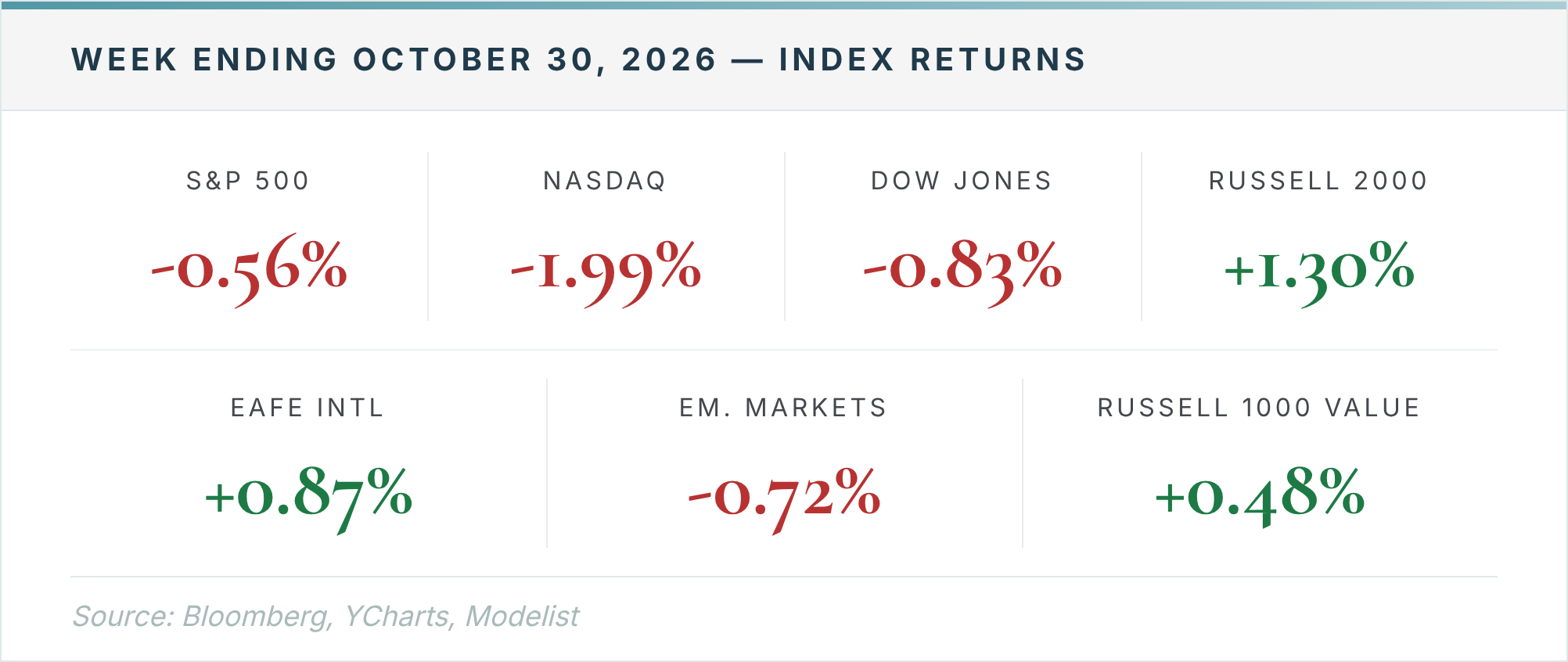
The economy grew faster than forecast last week, consumer confidence jumped, and nine of the 11 sectors in the S&P 500 finished higher. The S&P 500 itself fell 0.56%. Both of those facts are accurate, and the distance between them says more about how the index is built than about the economy.
What Happened
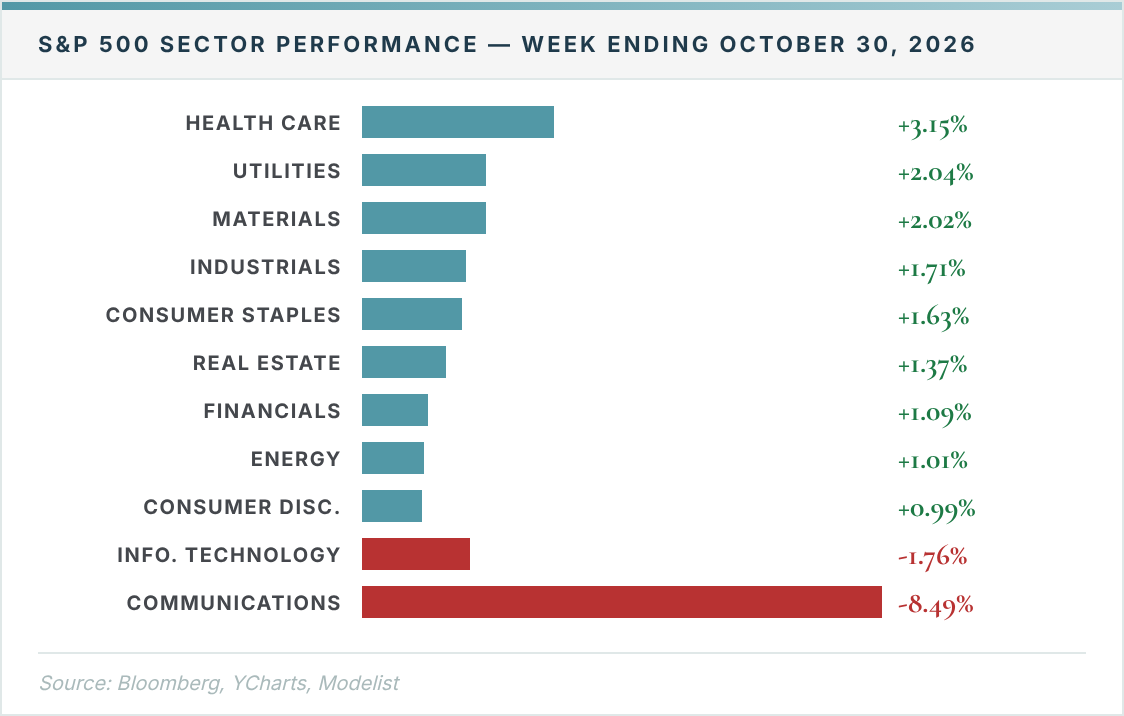
The losses were narrow. Communication Services fell 8.49% for the week and Information Technology fell 1.76%. Every other sector rose, led by Health Care at 3.15% and Utilities at 2.04%. Smaller companies gained too: the Russell 2000 rose 1.30%, while the Russell 1000 Growth index lost 1.70% and the Russell 1000 Value index gained 0.48%.
Two sectors outweighed nine because the S&P 500 weights each company by its market value, and many of the largest companies sit in those two sectors. When a handful of them move together, they can set the direction of the whole index. Last week, results from two of the biggest renewed questions about whether their spending on AI earns enough to justify it, and the index followed them rather than the economic data.
The week was part of a longer pattern. For October through Friday's close, Communication Services was down 15.11% and the Russell 1000 Growth index was down 6.09%, while the Russell 1000 Value index was up 4.38%. Three weeks ago we wrote that an index average can hide a wide spread underneath it, using emerging markets as the example. October showed the same thing in the index most American retirement accounts track: its result has been set by a small group of companies, while most of what it holds went the other way.
The economic data gave the index little reason to fall. Third-quarter GDP grew at a 3.4% annual rate against a 3.2% forecast, up from 2.2% in the second quarter. The Conference Board's consumer confidence index rose to 91.7 against expectations of 81, and weekly jobless claims held at 194,000. The Federal Reserve kept its target range at 3.75% to 4.00%, and core PCE inflation ran at 3.1% for the twelve months through September.
What It Means for Your Retirement Plan
The concentration did not arrive in one week. Years of strong returns from the largest companies have raised their weight inside index funds, workplace plans and individual positions bought when the shares cost less. For someone approaching retirement, the largest single exposure in the portfolio may now be a group of companies they never decided to overweight. Weeks like this one make that visible. An index fund is doing what it was built to do when it holds companies in proportion to their size. The planning question is whether that proportion still fits what the money is for, and whether anyone has checked since the shares grew.
Bringing that exposure back in line is usually called rebalancing, which makes it sound like a pure investment decision. In a taxable account it is also a tax decision. Selling shares that have grown for years realizes capital gains, and California taxes realized capital gains as ordinary income, at the same rates as a salary. Which year the gains land in, and what else is on that year's return, change what the same trim costs. That is the work of the Tax Management Journey®: tax decisions weighed across years rather than one return at a time, so a portfolio adjustment and the return that follows it are planned together. With under nine weeks left in 2026, the calendar is part of that decision. This week's Planning Insight explains how December 31 decides which year a gain counts in.
What We're Watching
The ISM Services index for October on Wednesday, November 4, and the October jobs report from the Bureau of Labor Statistics on Friday, November 6.
Is Your Largest Holding One You Chose?
If you are not getting your questions on this topic answered by your current financial advisor and would like to discuss working with us, you may request a meeting here.
Schedule your 20-Minute Due-Diligence Q&A Conversation