
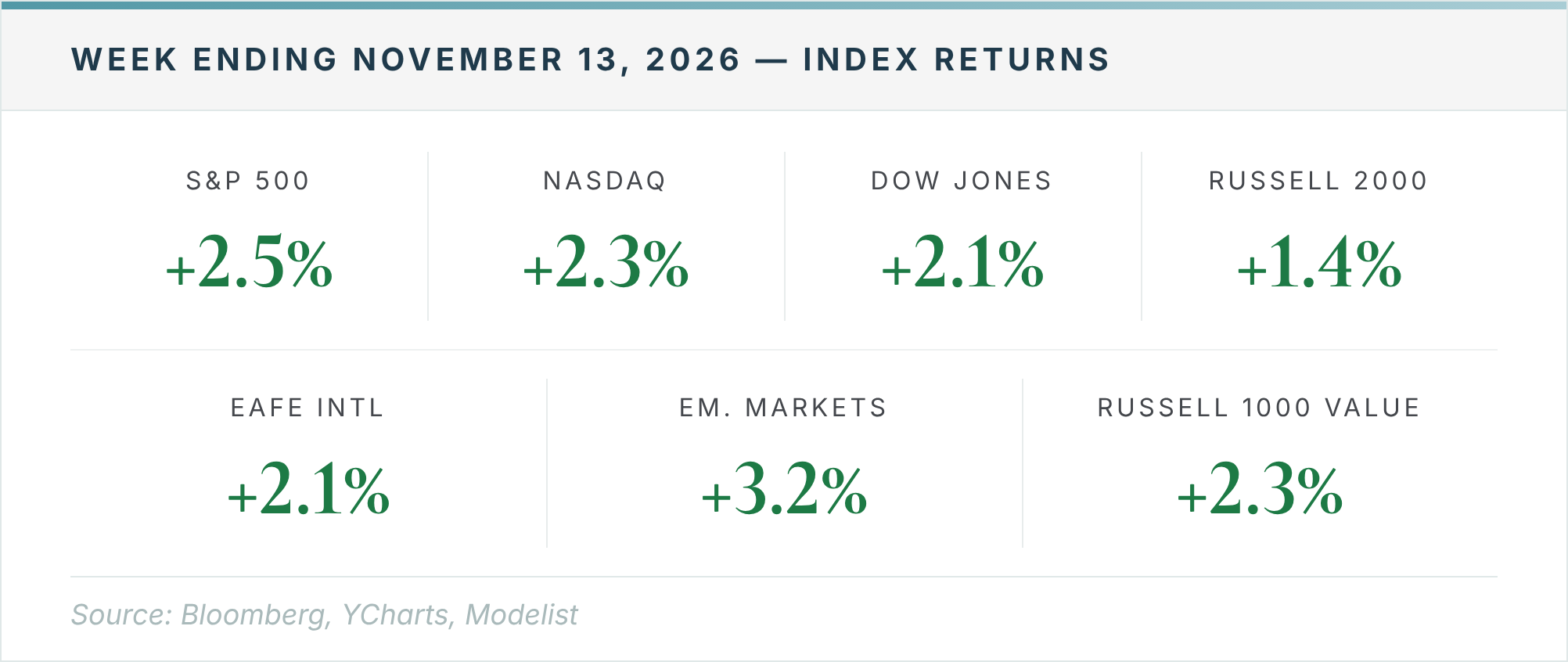
Long Bonds Fell 2.9% in a Week Stocks Rose 2.5%. "Safe" Has a Maturity Date.
Last week the S&P 500 gained 2.5% and all 11 of its sectors rose. The losses landed in the part of a portfolio most people think of as the safe part: long-term Treasury bonds fell 2.9%, while Treasury bills, issued by the same government, gained 0.1%. What separated them was how many years each one locks in a rate.
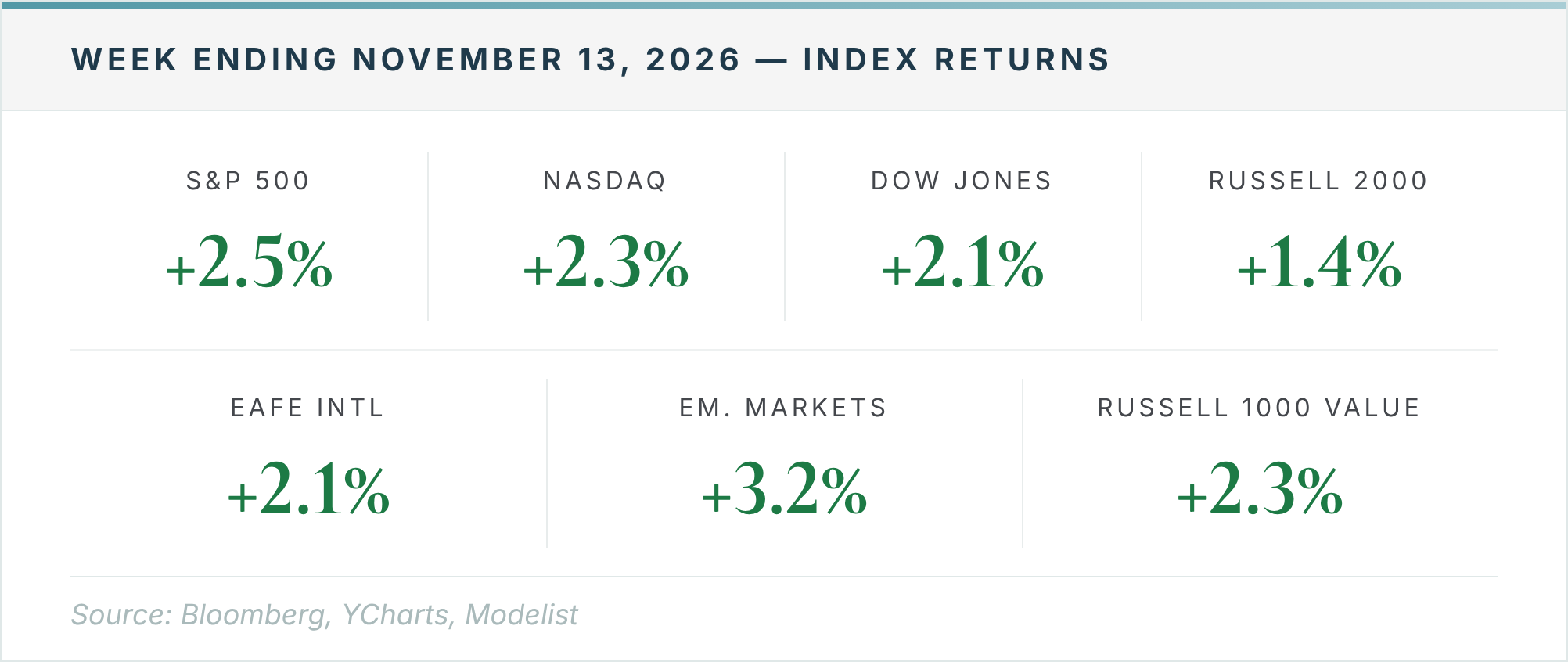
What Happened
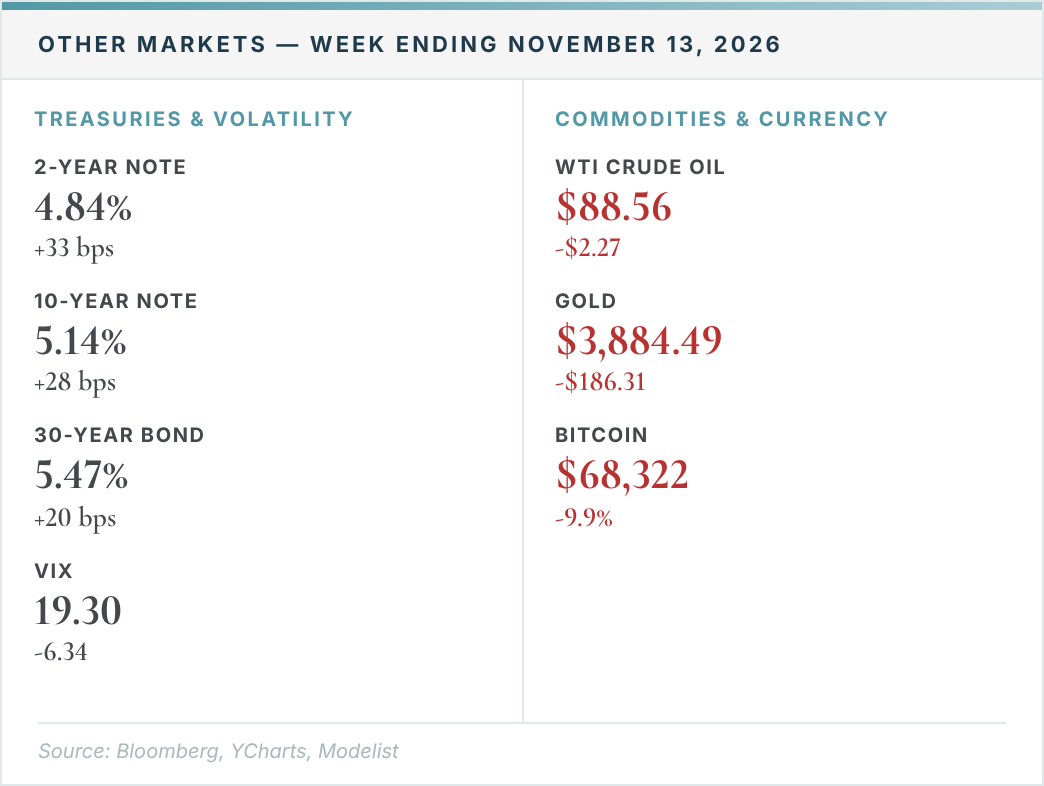
The week's news was inflation. The Bureau of Labor Statistics reported that consumer prices rose 0.4% in October and producer prices rose 0.3%. Treasury yields rose across the curve the same week: the 2-year climbed 33 basis points to 4.84%, the 10-year 28 basis points to 5.14%, and the 30-year 20 basis points to 5.47%.
Four weeks ago we wrote that bonds had rallied despite 3.7% inflation, and that next year's income shouldn't depend on that repeating. Last week it went the other way. The Bloomberg US Aggregate bond index lost 1.5% and is now down 1.6% for 2026. Gold fell $186 an ounce and Bitcoin fell 9.9%. Three assets often described as protection all lost ground in a week the stock market rose.
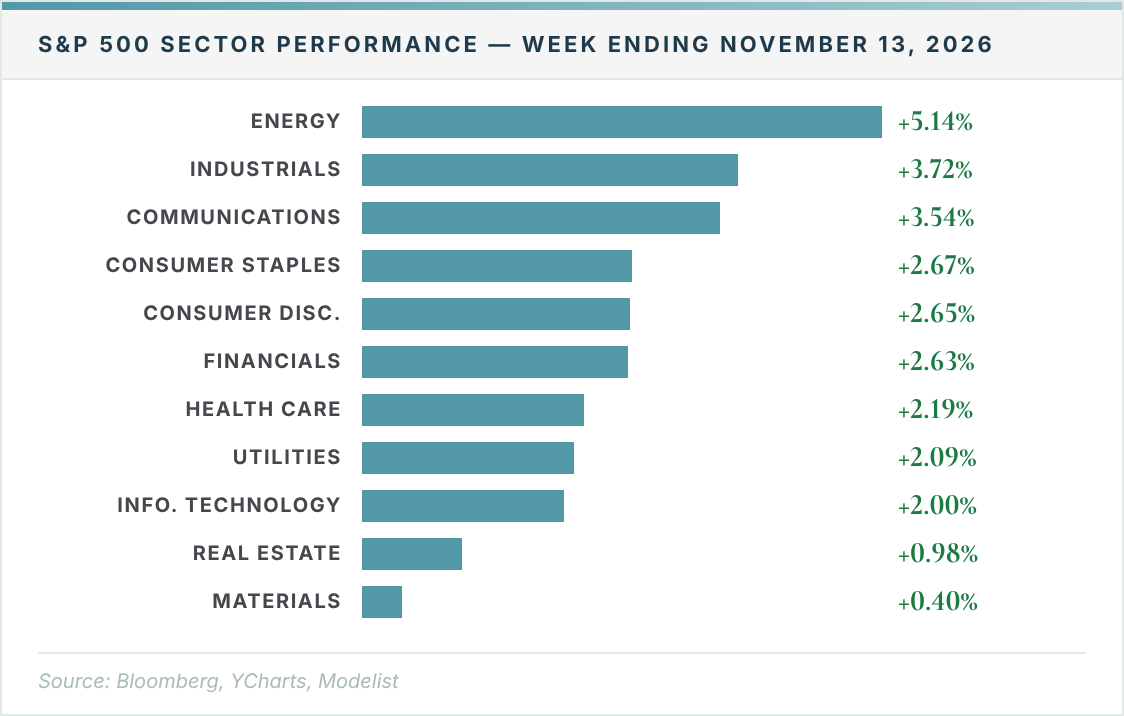
The idea that bonds rise when stocks fall depends on what kind of news a week brings. When the concern is slowing growth, high-quality bonds have often gained as stocks dropped. When the news is that prices are rising faster, a fixed interest payment buys less, and bond prices can fall regardless of what stocks do. Last week stocks rose broadly, led by Energy at 5.1% and Industrials at 3.7%, and bonds still lost money. A bond held as a hedge against falling stocks offered no offset to rising inflation data.
Inside the bond market, the losses lined up with one number. Duration measures how much a bond's price moves when rates change, stated in years. The long Treasury index carries a duration of 13.7 years and lost 2.9%. The Aggregate, at 5.9 years, lost 1.5%. Treasury bills, at about two months, gained 0.1%. The year so far tells the same story: Treasury bills are up 3.3% in 2026 and long Treasuries are down 5.3%.
Rising yields have a second effect that gets less attention. The move that cut the price of bonds already owned also raised what new money earns. The Aggregate's yield to worst, the lowest yield its bonds would pay if held to maturity or call without default, is now 5.49%. The 2-year Treasury now yields 1.37 percentage points more than it did at the start of 2026.
What It Means for Your Retirement Plan
Whether last week hurt depends on when the money will be spent. Money that funds the next two or three years of withdrawals can't wait for rates to come back down, so a bond with a 13-year duration is a poor fit for it, however strong the issuer's credit. Money meant for withdrawals a decade out can sit through a week like this one, and the higher yield on its reinvested interest works in its favor over that span. The same bond can be the right holding in one part of a plan and the wrong one in another. Short and long Treasuries share an issuer and a credit rating, yet last week the short-term Treasury index was flat while the long index lost 2.9%.
That is the logic of The Bucket Plan®: assets are segmented by when they will be needed, and risk is set for each segment. Under that approach, the safety of near-term money is judged by how far its value can move before the withdrawal date, not by the label on the security.
A week like this one is a useful time to check which of your bonds are funding the next few years of withdrawals, and how far their value could move before you spend them. That number is easier to find before the next inflation report than after it. If you are not getting your questions on this topic answered by your current financial advisor and would like to discuss working with us, you may request a meeting here.
Schedule your 20-Minute Due-Diligence Q&A Conversation
What We're Watching
Tuesday, November 17: October retail sales from the Census Bureau at 8:30 a.m. Eastern, and October industrial production from the Federal Reserve at 9:15 a.m. Eastern.
Wednesday, November 18: minutes of the Federal Reserve's October 27–28 meeting, scheduled for 2:00 p.m. Eastern.