

The Best Inflation Report in a Year Arrived — and Stocks Fell. What Got Repriced Wasn't the Economy.
June inflation came in well below what forecasters expected — consumer prices, core prices, and producer prices all eased at once. Stocks fell anyway, with most of the damage arriving Friday. If that sequence feels backwards, it's because the week's selloff was never really about the economy.
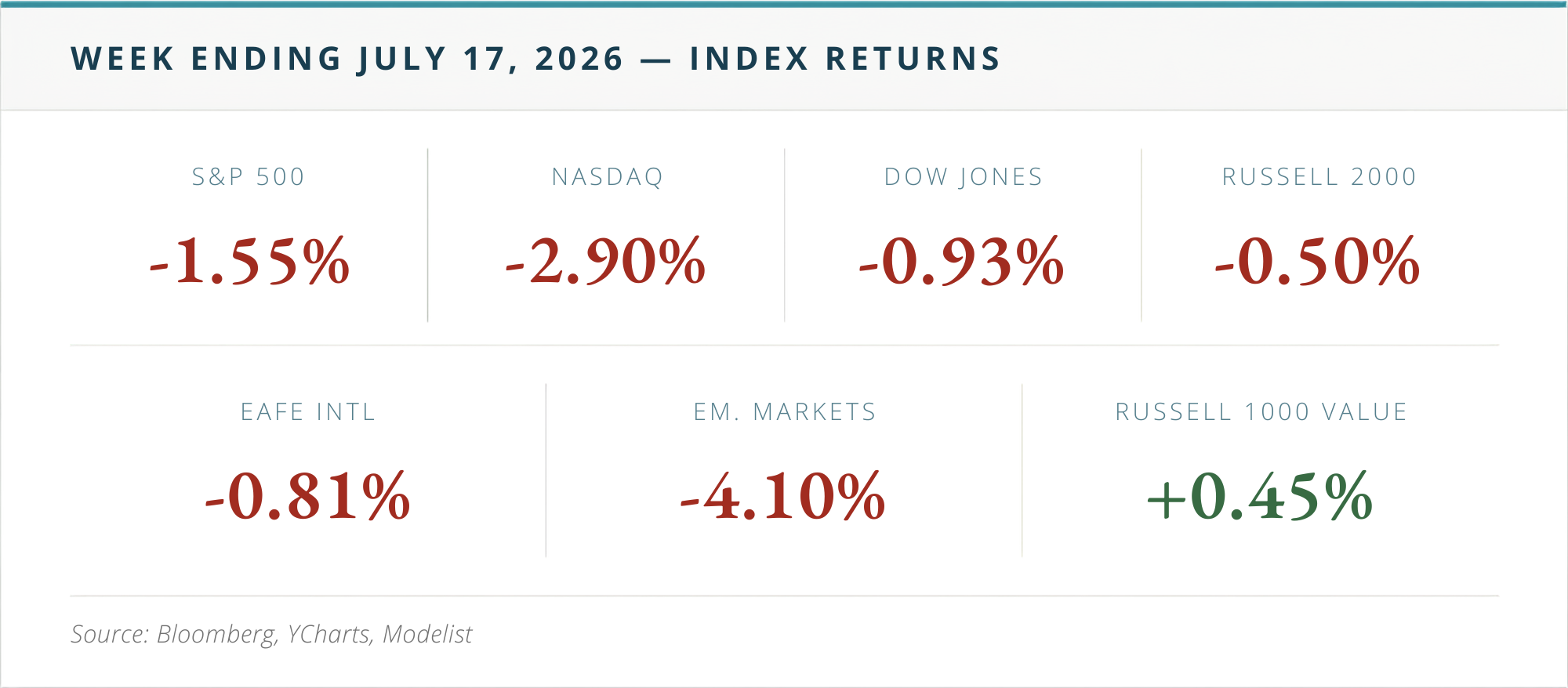
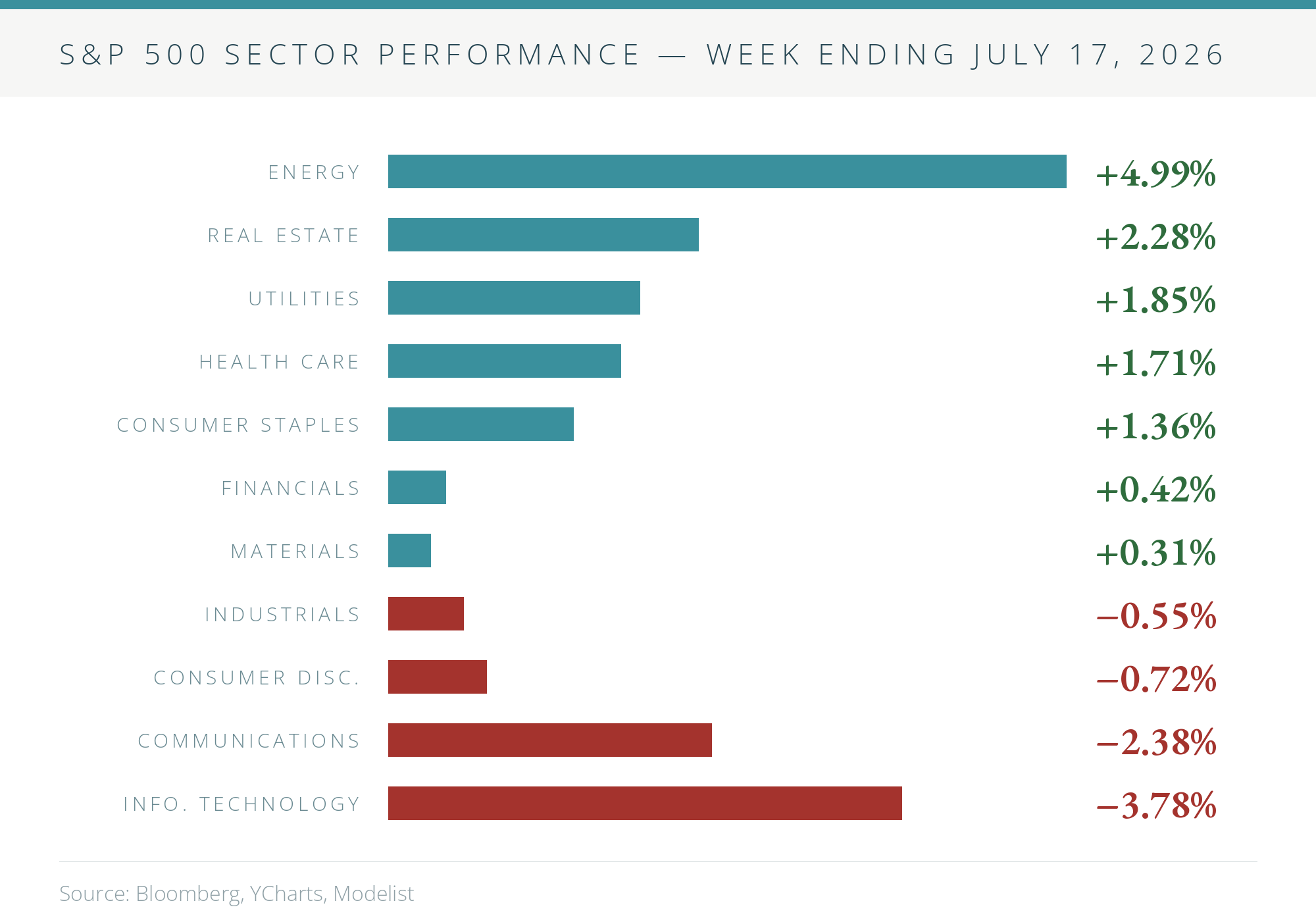
Look past the index level and the week splits cleanly in two. The Nasdaq gave up 2.90%, Information Technology fell 3.78%, and Communications declined 2.38% alongside it. Semiconductor names took the hardest hits at home and abroad — declines in South Korean and Taiwanese chipmakers pushed emerging markets down 4.10%. And yet seven of the S&P 500's eleven sectors finished the week higher. Energy rose 4.99%, Real Estate gained 2.28%, Utilities added 1.85%, and the Russell 1000 Value index — the unglamorous side of the U.S. market — gained 0.45% in a week the S&P 500 fell 1.55%. That is not what a market-wide selloff looks like. It's what the repricing of a single trade looks like.
The AI Trade Gets Its Audit
The trade in question is artificial intelligence. The question has shifted: no longer whether AI spending is growing — it clearly is — but whether profits can justify the valuations and the enormous capital budgets behind them. Several major banks and technology suppliers reported solid results this week, and AI-linked stocks sold off anyway. That is what an audit looks like: the market has stopped paying for the story and started asking for the receipts. Earnings guidance over the coming weeks will determine whether leadership returns to chips, migrates toward software and cloud, or broadens into sectors with less demanding valuations. None of those outcomes is a catastrophe. All of them are a repricing.
The Inflation Fight Moved to the Oil Market
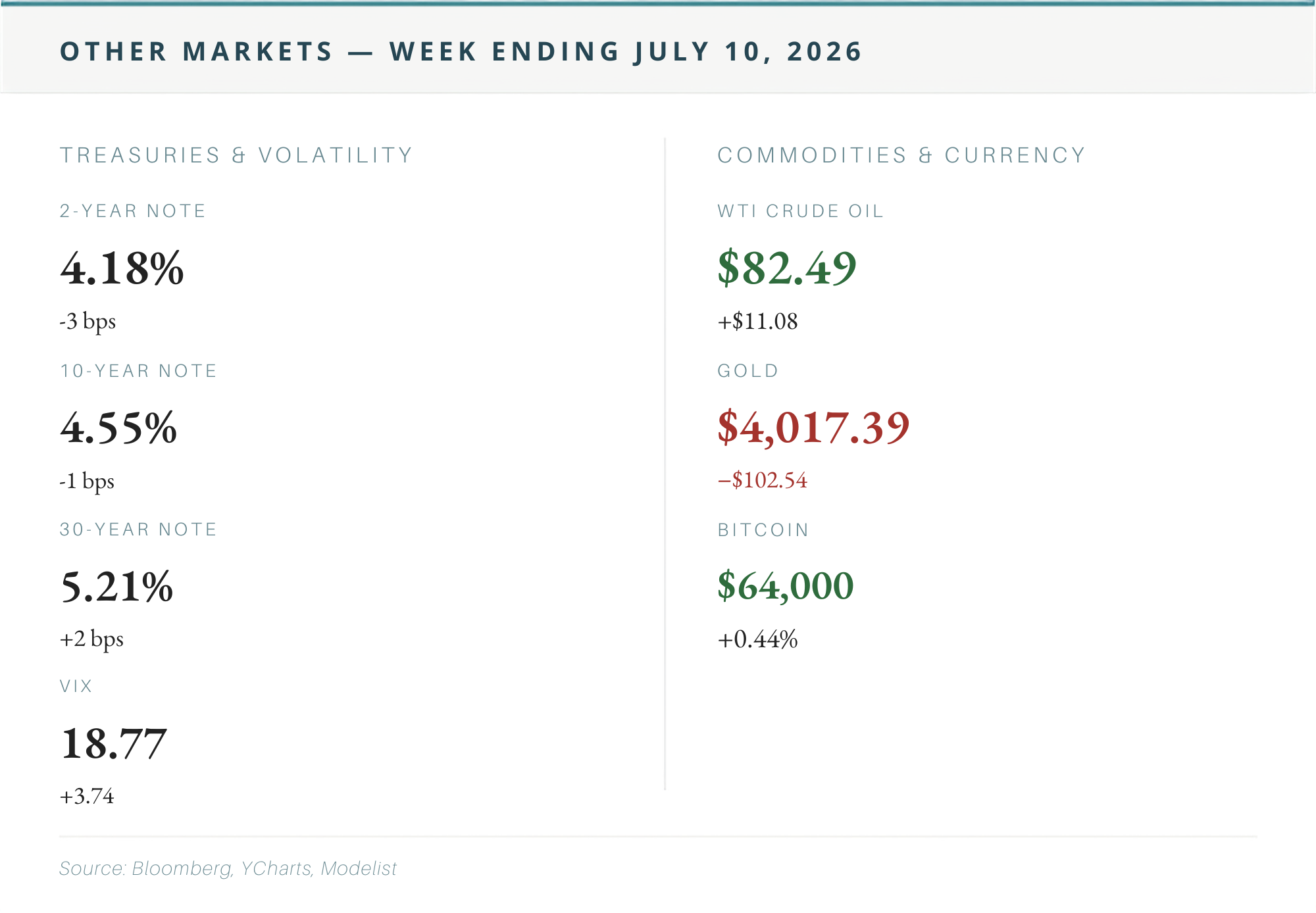
The week's economic news, meanwhile, was genuinely good. Headline and core consumer prices both printed far below economists' forecasts, producer prices followed the next day, and retail sales held steady — a combination that lowers the risk of another rate increase. But the bond market barely reacted: the 2-year yield slipped 3 basis points to 4.18%, and the 10-year eased 1 basis point to 4.55%. The hesitation had a reason, and it sat in the oil market. Rising military exchanges in the Middle East sent crude up $11.08 to $82.49 a barrel — and a sustained energy shock is precisely the kind of thing that could unwind the progress June's data just delivered. The VIX rising 3.74 points to 18.77 says the market understands the tension. Whether the cooling in prices proves durable, or turns out to be a window before energy costs reappear in the data, is the question the coming months will answer — and it's why good inflation news bought so little celebration this week.
The Bottom Line
A week like this one is a live demonstration of what concentration actually feels like. A portfolio built to mirror the major indexes increasingly rides on a handful of AI-linked names — which means it behaved like the Nasdaq this week, even while most of the market rose. That isn't a prediction about AI; it's a fact about construction. It's also why the Bucket Plan® segments your money by when you'll need it: when near-term income is held in assets that don't depend on how an earnings season resolves, an audit of the AI trade becomes something you observe rather than something you absorb.
If Friday's decline showed up in your account more forcefully than a 1.55% index move should, that's worth understanding before the next earnings cycle — not after it. A short conversation can show you how much of your plan is riding on a single trade, and whether that's by design or by drift.
Schedule a 20-Minute Due-Diligence Q&A Call →