
facebook twitter instagram linkedin google youtube vimeo tumblr yelp rss email podcast phone blog search brokercheck brokercheck Play Pause
The Data Tells A Different Story Than The People Do Thumbnail

The Data Tells A Different Story Than The People Do

The Markets

Investor mood matters.

Over the past month, we’ve seen five sharp stock market declines – and five rebounds, reported Charles Riley of Bloomberg. He pointed out that market declines often go hand-in-hand with a change in the economic outlook, but that’s not the case this time. The economy appears to be doing reasonably well.

The declines and recoveries reflect investor sentiment and uncertainty, reported Carmen Reinicke, Alexandra Semenova, Vildana Hajric, and Michael MacKenzie of Bloomberg. For example, investors are worried that:

  • Artificial Intelligence (AI) will disrupt industries, altering stock valuations. AI has the potential to change the way companies operate. Last week, “a new AI automation tool…sparked a $285 billion rout in stocks across the software, financial services and asset management sectors…as investors raced to dump shares with even the slightest exposure,” reported Reinicke, Joe Easton, and Henry Ren of Bloomberg.
  • Technology companies are overspending. AI companies have been spending enormous amounts of money on infrastructure hoping the investments will pay off in the future. Investors are concerned current spending will hurt future profits, reported Martin Baccardax of Barron’s. As a result, investors are becoming more selective about the technology stocks they choose.

Investors also have moved assets from the technology sector into other market sectors. “With unease around AI still unresolved, investors are looking elsewhere for value and finding it. Shares of companies with little direct tech exposure, from consumer staples to energy producers, are enjoying a rare moment in the sun. But it’s less a vote of no confidence in tech than a search for businesses that stand to benefit from a firmer economy,” reported John Authers and Richard Abbey of Bloomberg.

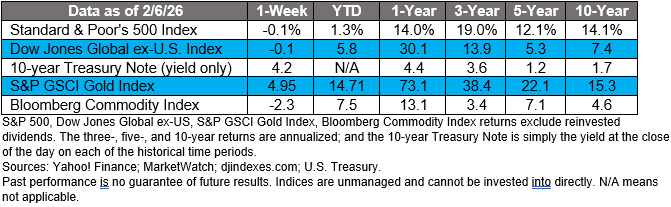
Last week, “Treasuries surged, driving yields down the most in months, as signs of weakness in the U.S. job market helped deepen the retreat from stocks, commodities and cryptocurrencies and boost wagers on Federal Reserve policy easing,” reported Elizabeth Stanton and Miles J. Herszenhorn of Bloomberg. The Standard & Poor’s 500 and Nasdaq Composite Indexes moved lower, while the blue-chip Dow Jones Industrial Average surpassed 50,000 for the first time.


The Data Tells A Different Story Than The People Do

Before you read any further, ask yourself these two questions:

  1. How is the U.S. economy doing?
  2. Why did you answer the way you did?

Economic data suggest the U.S. economy is doing reasonably well. At the end of January, the Federal Reserve reported, “Available indicators suggest that economic activity has been expanding at a solid pace. Job gains have remained low, and the unemployment rate has shown some signs of stabilization. Inflation remains somewhat elevated.”

What do Americans think about the economy?

While data show the economy doing well, many Americans aren’t feeling it. In February, the University of Michigan’s Surveys of Consumers Director Joanne Hsu reported:

“While sentiment is currently the highest since August 2025, recent monthly increases have been small—well under the margin of error—and the overall level of sentiment remains very low from a historical perspective. Concerns about the erosion of personal finances from high prices and elevated risk of job loss continue to be widespread.”

Last Fall, Pew Research asked Americans how the economy was doing. Seventy-four percent thought the economy was in fair to poor condition because of inflation, tariffs, the cost of living, wealth inequality, the cost of food and groceries, low wages, and a lack of good-paying jobs.

In contrast, 26 percent of participants said the economy was in good or excellent condition. The group cited general economic growth or improvement, lower inflation, stock market performance, and low unemployment as reasons for its view.

Overall, participants’ top concerns were:

  • The price of food and consumer goods          65 percent
  • The cost of housing                                         61 percent
  • The price of gas and energy                           45 percent
  • Being unable to find a job                               42 percent
  • The performance of the stock market            19 percent

Economic anxiety is a global issue

Last week, Gallup reported that economic anxiety is a global issue. Its survey of people in 107 countries found the economy topped the list of national concerns. Twenty-three percent of the people Gallup surveyed said they were concerned about the standard of living, high prices, and low wages in their countries. Jon Clifton and Benedict Vigers of Gallup reported:

“Gross Domestic Product (GDP) — the value of goods and services produced in a specified period — is a standard metric that countries, and their leaders, use to assess their progress. However, annual GDP growth bears little relation to whether people identify the economy as their country's top challenge. Instead, there is a much stronger relationship between how people feel about their own household income and their perceptions of the economy as a national challenge.”


Weekly Inspiration

“We don't see things as they are, we see them as we are.”

― Anonymous

Best Regards,
California Retirement Advisors


Investment advisory services offered through Mutual Advisors, LLC DBA California Retirement Advisors, a SEC registered investment advisor. Securities offered through Mutual Securities, Inc., member FINRA/SIPC. Mutual Securities, Inc. and Mutual Advisors, LLC are affiliated companies. CA Insurance license #0B09076. This content is developed from sources believed to be providing accurate information and provided by California Retirement Advisors. It may not be used for the purpose of avoiding any federal tax penalties. Please consult legal or tax professionals for specific information regarding your individual situation. The opinions expressed and material provided are for general information and should not be considered a solicitation for the purchase or sale of any security. California Retirement Advisors, nor any of its members, are tax accountants or legal attorneys and do not provide tax or legal advice. For tax or legal advice, you should consult your tax or legal professional.
The information being provided is strictly as a courtesy. When you click on any of the links provided here, you are leaving this website and viewing information provided by a third party. We make no representation as to the completeness or accuracy of information provided by any third-party website. Nor is the company liable for any direct or indirect technical or system issues or any consequences arising out of your access to, or your use of third-party technologies, websites, information and programs made available through this website. By accessing these calculators, you assume total responsibility and risk for your use of the third-party website.
* These views are those of Carson Coaching, not the presenting Representative, the Representative’s Broker/Dealer, or Registered Investment Advisor, and should not be construed as investment advice.
* Government bonds and Treasury Bills are guaranteed by the U.S. government as to the timely payment of principal and interest and, if held to maturity, offer a fixed rate of return and fixed principal value.  However, the value of fund shares is not guaranteed and will fluctuate.
* Corporate bonds are considered higher risk than government bonds but normally offer a higher yield and are subject to market, interest rate and credit risk as well as additional risks based on the quality of issuer coupon rate, price, yield, maturity, and redemption features.
* The Standard & Poor's 500 (S&P 500) is an unmanaged group of securities considered to be representative of the stock market in general. You cannot invest directly in this index.
* All indexes referenced are unmanaged. The volatility of indexes could be materially different from that of a client’s portfolio. Unmanaged index returns do not reflect fees, expenses, or sales charges. Index performance is not indicative of the performance of any investment. You cannot invest directly in an index.
* The Dow Jones Global ex-U.S. Index covers approximately 95% of the market capitalization of the 45 developed and emerging countries included in the Index.
* The 10-year Treasury Note represents debt owed by the United States Treasury to the public. Since the U.S. Government is seen as a risk-free borrower, investors use the 10-year Treasury Note as a benchmark for the long-term bond market.
* Gold represents the 3:00 p.m. (London time) gold price as reported by the London Bullion Market Association and is expressed in U.S. Dollars per fine troy ounce. The source for gold data is Federal Reserve Bank of St. Louis (FRED), https://fred.stlouisfed.org/series/GOLDPMGBD228NLBM.
* The Bloomberg Commodity Index is designed to be a highly liquid and diversified benchmark for the commodity futures market. The Index is composed of futures contracts on 19 physical commodities and was launched on July 14, 1998.
* The DJ Equity All REIT Total Return Index measures the total return performance of the equity subcategory of the Real Estate Investment Trust (REIT) industry as calculated by Dow Jones.
* The Dow Jones Industrial Average (DJIA), commonly known as “The Dow,” is an index representing 30 stock of companies maintained and reviewed by the editors of The Wall Street Journal.
* The NASDAQ Composite is an unmanaged index of securities traded on the NASDAQ system.
* International investing involves special risks such as currency fluctuation and political instability and may not be suitable for all investors. These risks are often heightened for investments in emerging markets.
* Yahoo! Finance is the source for any reference to the performance of an index between two specific periods.
* The risk of loss in trading commodities and futures can be substantial. You should therefore carefully consider whether such trading is suitable for you in light of your financial condition. The high degree of leverage is often obtainable in commodity trading and can work against you as well as for you. The use of leverage can lead to large losses as well as gains.
* Opinions expressed are subject to change without notice and are not intended as investment advice or to predict future performance.
* Economic forecasts set forth may not develop as predicted and there can be no guarantee that strategies promoted will be successful.
* Past performance does not guarantee future results. Investing involves risk, including loss of principal.
* The foregoing information has been obtained from sources considered to be reliable, but we do not guarantee it is accurate or complete.
* There is no guarantee a diversified portfolio will enhance overall returns or outperform a non-diversified portfolio. Diversification does not protect against market risk.
* Asset allocation does not ensure a profit or protect against a loss.
* Consult your financial professional before making any investment decision.
Sources: 
https://www.bloomberg.com/news/newsletters/2026-02-05/crypto-markets-get-trapped-in-a-downward-spiral?cmpid=020526_marketsdaily&utm_medium=email&utm_source=newsletter&utm_term=260205&utm_campaign=marketsdaily or go to https://resources.carsongroup.com/hubfs/WMC-Source/2026/02-09-26-Bloomberg-Crypto-Markets-Get-Trapped%20-%201.pdf
https://www.bloomberg.com/news/articles/2026-02-05/wall-street-s-favorite-trades-collapse-as-market-selloff-deepens or go to https://resources.carsongroup.com/hubfs/WMC-Source/2026/02-09-26-Bloomberg-Wall-Streets-Favorite%20-%202.pdf
https://www.bloomberg.com/news/articles/2026-02-03/legal-software-stocks-plunge-as-anthropic-releases-new-ai-tool or go to https://resources.carsongroup.com/hubfs/WMC-Source/2026/02-09-26-Bloomberg-Anthropic-AI-Tool%20-%203.pdf
https://www.barrons.com/articles/google-stock-market-ai-selloff-alphabet-4f7d2693 or go to https://resources.carsongroup.com/hubfs/WMC-Source/2026/02-09-26-Barrons-Google-Needed-to-Calm%20-%204.pdf
https://www.bloomberg.com/opinion/newsletters/2026-02-05/value-is-back-in-vogue-but-don-t-write-tech-off-yet or go to https://resources.carsongroup.com/hubfs/WMC-Source/2026/02-09-26-Bloomberg-Value-is-Back-In-Vogue%20-%205.pdf
https://www.bloomberg.com/news/articles/2026-02-05/us-bonds-rally-as-job-market-angst-backs-wagers-on-fed-rate-cuts or go to https://resources.carsongroup.com/hubfs/WMC-Source/2026/02-09-26-Bloomberg-Treasuries-Rally-As-Deepening-Slump%20-%206.pdf
https://www.barrons.com/market-data?mod=BOL_TOPNAV or go to https://resources.carsongroup.com/hubfs/WMC-Source/2026/02-09-26-Barrons-DJIA-S&P-Nasdaq%20-%207.pdf
https://www.federalreserve.gov/newsevents/pressreleases/monetary20260128a.htm or go to https://resources.carsongroup.com/hubfs/WMC-Source/2026/02-09-26-APSA-The-Impact-of-Job-Growth%20-%208.pdf
https://www.sca.isr.umich.edu
https://www.pewresearch.org/short-reads/2025/10/03/most-americans-continue-to-rate-the-us-economy-negatively-as-partisan-gap-widens/
https://news.gallup.com/poll/701438/economic-anxiety-global-problem.aspx
https://quoteinvestigator.com/2014/03/09/as-we-are/