
facebook twitter instagram linkedin google youtube vimeo tumblr yelp rss email podcast phone blog search brokercheck brokercheck Play Pause
Things to Watch in 2026 Thumbnail

Things to Watch in 2026

The Markets

Lots of people are willing to predict what’s ahead. 

If the past is prologue, few will be accurate. You don’t have to look far to find an example. In 2023, a majority of economists agreed recession was ahead. They were wrong. Tyler Cowen of Bloomberg explained:

“Last year at this time, 85 [percent] of economists in one poll predicted a recession this year — and that was an optimistic take compared to the 100 [percent] probability of a recession forecast two months earlier…And yet none of this has happened…most economists expect the U.S. to avoid a recession in 2024.”

Here are two predictions we’ve seen for 2026:

The U.S. stock market will move higher. During the last week of 2025, some on Wall Street were feeling quite enthusiastic about the year ahead. 

“At the big banks and the boutique investment shops, an optimistic consensus has taken hold: the U.S. stock market will rally in 2026 for a fourth straight year, marking the longest winning streak in nearly two decades,” reported Alexandra Semenova and Sagarika Jaisinghani of Bloomberg. “Not a single one of the 21 prognosticators surveyed by Bloomberg News is predicting a decline.”

The U.S. stock market will move lower. Contrarian investors see high levels of bullishness are a red flag. When a significant majority of investors is optimistic, contrarians tend to be pessimistic, and vice versa. For example, Andy Serwer of Barron’s took a contrarian viewpoint last week: 

“Unlike the usual prognosticators…I’m going to go out on a limb and say the market goes…down…I feel like the bull has been running on fumes a bit lately…between the administration messing with the economy’s biggest industry, healthcare, and brewing labor shortages, growth will surely be hindered.”

Despite abundant forecasts, it’s not possible to predict the future. 

“In a market shaped by unknowable global forces (wars, trade conflicts, etc.) and great innovations (artificial intelligence, miracle weight loss drugs, etc.), it’s simply not credible for anyone to know where the index will land in 12 months to the exact index point. It would take tremendous skill and a great deal of luck to even guess where earnings are going in that period, but the mercurial nature of market sentiment complicates the exercise even further,” explained Jonathan Levin in Bloomberg Opinion.

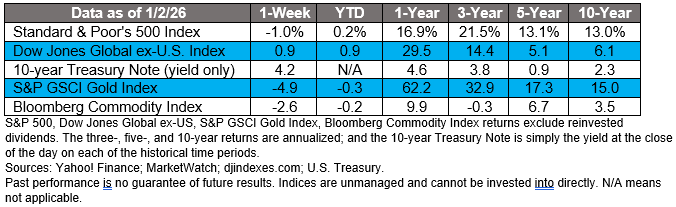
Major U.S. stock indexes posted attractive returns for 2025, although share prices declined on the last day of the year, reported Alex Veiga of AP News. For the week, major indexes finished lower. Yields on most U.S. Treasuries moved higher over the week.


Things to Watch in 2026

Global financial markets are like a Rube Goldberg machine – affected by a lot of factors in unpredictable ways. Bloomberg evaluated 700 calls from 60 financial institutions regarding the outlook for 2026. Sam Potter of Bloomberg reported on key themes identified in those calls, including: 

  • Artificial intelligence (AI). Optimism about AI is nearly universal, reported Potter. “Astronomical expenditure. Uncertain rates of return. Uneven pace of adoption. By now every firm on Wall Street is well aware of the risks surrounding the artificial intelligence boom. But when it comes to the year ahead, few advocate walking away from what they describe as a ‘revolutionary’ technology.” 
  • Interest rates (a.k.a. monetary policy). Financial markets already anticipate that global central banks will ease monetary policy, which means they will lower rates. The exception is the Bank of Japan. In the United States, “The [Federal Reserve] will come under increased political pressure to cut rates…but most firms think the market is currently pricing too many cuts,” reported Potter.
  • Government spending and taxes (a.k.a. fiscal policy). “Governments continue to stimulate their economies. In the U.S., the ‘Big Beautiful Bill’ includes tax cuts that should boost growth next year, while Germany has shifted from decades of fiscal restraint to a new era of significant borrowing and investment,” wrote a company cited by Bloomberg.
  • Tariffs and trade. There was some uncertainty about tariffs. “Although it’s possible the Supreme Court could strike down parts of the Trump administration’s tariff regime, the growing dependence on tariff revenue suggests the authorities will find ways to keep barriers in place,” opined one of the institutions. 
  • Inflation. Overall, institutions expect inflation to remain sticky, although some say it might move lower “Inflation likely to remain above Fed's target…but could drift down if one-off price increases from tariffs wane or economic activity weakens,” wrote one.
  • Geopolitics. As global tensions and crises continue, the unified global financial system may fragment, causing friction in the free market system. Potter cautioned that the overall view of institutions was, “…never underestimate the potential for geopolitical or trade-related shocks.” 
  • Depreciating U.S. dollar. When the value of the U.S. dollar falls relative to other countries’ currencies, it can make investments outside the U.S. more attractive than those inside the United States, stated an institution in the survey.

It’s interesting to note that government debt and deficits were not often mentioned. One firm stated, “Although there are many encouraging signs for the year ahead, there are also clear risks on the horizon, and investors should prepare for inevitable market pullbacks. Stocks are expensive. Sticky inflation and mounting government debt in the U.S., Europe and elsewhere are also cause for concern.”


Weekly Inspiration

“Write it on your heart

that every day is the best day in the year.

He is rich who owns the day, and no one owns the day

who allows it to be invaded with fret and anxiety.

Finish every day and be done with it.

You have done what you could.

Some blunders and absurdities, no doubt crept in.

Forget them as soon as you can, tomorrow is a new day;

begin it well and serenely, with too high a spirit

to be cumbered with your old nonsense.

This new day is too dear,

with its hopes and invitations,

to waste a moment on the yesterdays.”

—Ralph Waldo Emerson, Writer and poet

Best Regards,
California Retirement Advisors


Investment advisory services offered through Mutual Advisors, LLC DBA California Retirement Advisors, a SEC registered investment advisor. Securities offered through Mutual Securities, Inc., member FINRA/SIPC. Mutual Securities, Inc. and Mutual Advisors, LLC are affiliated companies. CA Insurance license #0B09076. This content is developed from sources believed to be providing accurate information and provided by California Retirement Advisors. It may not be used for the purpose of avoiding any federal tax penalties. Please consult legal or tax professionals for specific information regarding your individual situation. The opinions expressed and material provided are for general information and should not be considered a solicitation for the purchase or sale of any security. California Retirement Advisors, nor any of its members, are tax accountants or legal attorneys and do not provide tax or legal advice. For tax or legal advice, you should consult your tax or legal professional.
The information being provided is strictly as a courtesy. When you click on any of the links provided here, you are leaving this website and viewing information provided by a third party. We make no representation as to the completeness or accuracy of information provided by any third-party website. Nor is the company liable for any direct or indirect technical or system issues or any consequences arising out of your access to, or your use of third-party technologies, websites, information and programs made available through this website. By accessing these calculators, you assume total responsibility and risk for your use of the third-party website.
* These views are those of Carson Coaching, not the presenting Representative, the Representative’s Broker/Dealer, or Registered Investment Advisor, and should not be construed as investment advice.
* Government bonds and Treasury Bills are guaranteed by the U.S. government as to the timely payment of principal and interest and, if held to maturity, offer a fixed rate of return and fixed principal value.  However, the value of fund shares is not guaranteed and will fluctuate.
* Corporate bonds are considered higher risk than government bonds but normally offer a higher yield and are subject to market, interest rate and credit risk as well as additional risks based on the quality of issuer coupon rate, price, yield, maturity, and redemption features.
* The Standard & Poor's 500 (S&P 500) is an unmanaged group of securities considered to be representative of the stock market in general. You cannot invest directly in this index.
* All indexes referenced are unmanaged. The volatility of indexes could be materially different from that of a client’s portfolio. Unmanaged index returns do not reflect fees, expenses, or sales charges. Index performance is not indicative of the performance of any investment. You cannot invest directly in an index.
* The Dow Jones Global ex-U.S. Index covers approximately 95% of the market capitalization of the 45 developed and emerging countries included in the Index.
* The 10-year Treasury Note represents debt owed by the United States Treasury to the public. Since the U.S. Government is seen as a risk-free borrower, investors use the 10-year Treasury Note as a benchmark for the long-term bond market.
* Gold represents the 3:00 p.m. (London time) gold price as reported by the London Bullion Market Association and is expressed in U.S. Dollars per fine troy ounce. The source for gold data is Federal Reserve Bank of St. Louis (FRED), https://fred.stlouisfed.org/series/GOLDPMGBD228NLBM.
* The Bloomberg Commodity Index is designed to be a highly liquid and diversified benchmark for the commodity futures market. The Index is composed of futures contracts on 19 physical commodities and was launched on July 14, 1998.
* The DJ Equity All REIT Total Return Index measures the total return performance of the equity subcategory of the Real Estate Investment Trust (REIT) industry as calculated by Dow Jones.
* The Dow Jones Industrial Average (DJIA), commonly known as “The Dow,” is an index representing 30 stock of companies maintained and reviewed by the editors of The Wall Street Journal.
* The NASDAQ Composite is an unmanaged index of securities traded on the NASDAQ system.
* International investing involves special risks such as currency fluctuation and political instability and may not be suitable for all investors. These risks are often heightened for investments in emerging markets.
* Yahoo! Finance is the source for any reference to the performance of an index between two specific periods.
* The risk of loss in trading commodities and futures can be substantial. You should therefore carefully consider whether such trading is suitable for you in light of your financial condition. The high degree of leverage is often obtainable in commodity trading and can work against you as well as for you. The use of leverage can lead to large losses as well as gains.
* Opinions expressed are subject to change without notice and are not intended as investment advice or to predict future performance.
* Economic forecasts set forth may not develop as predicted and there can be no guarantee that strategies promoted will be successful.
* Past performance does not guarantee future results. Investing involves risk, including loss of principal.
* The foregoing information has been obtained from sources considered to be reliable, but we do not guarantee it is accurate or complete.
* There is no guarantee a diversified portfolio will enhance overall returns or outperform a non-diversified portfolio. Diversification does not protect against market risk.
* Asset allocation does not ensure a profit or protect against a loss.
* Consult your financial professional before making any investment decision.
Sources: 
https://www.bloomberg.com/opinion/articles/2023-12-26/what-recession-how-so-many-economists-got-it-so-wrong or go to https://resources.carsongroup.com/hubfs/WMC-Source/2026/01-05-26-Bloomberg-How-Were-So-Many-Economists%20-%201.pdf
https://www.bloomberg.com/news/articles/2025-12-29/bulls-only-every-wall-street-analyst-now-predicts-a-stock-rally?embedded-checkout=true or go to https://resources.carsongroup.com/hubfs/WMC-Source/2026/01-05-26-Bloomberg-Every-Wall-Street-Analyst%20-%202.pdf
https://www.barrons.com/articles/2026-predictions-fed-stocks-ai-sports-4cfa6257?mod=hp_LONGREADER_A_1 or go to https://resources.carsongroup.com/hubfs/WMC-Source/2026/01-05-26-Barrons-Heres-What-Will-Surely-Happen%20-%203.pdf
https://www.bloomberg.com/opinion/articles/2025-12-22/wall-street-is-bullish-on-2026-stock-gains-assume-that-s-wrong or go to https://resources.carsongroup.com/hubfs/WMC-Source/2026/01-05-26-Bloomberg-Wall-Street-is-Bullish%20-%204.pdf
https://apnews.com/article/stock-markets-2026-inflation-rates-fed-tariffs-fccc61b72ed242f62000add1575707d0
https://www.barrons.com/market-data?mod=BOL_TOPNAV or go to https://resources.carsongroup.com/hubfs/WMC-Source/2026/01-05-26-Barrons-DJIA-S7P-Nasdaq%20-%206.pdf
https://home.treasury.gov/resource-center/data-chart-center/interest-rates/TextView?type=daily_treasury_yield_curve&field_tdr_date_value=2025 and https://home.treasury.gov/resource-center/data-chart-center/interest-rates/TextView?type=daily_treasury_yield_curve&field_tdr_date_value=2026 or go to https://resources.carsongroup.com/hubfs/WMC-Source/2026/01-05-26-US-Sept-of-Treasury-Daily-Treasury-Rates%20-%207.pdf
https://www.bloomberg.com/graphics/2026-investment-outlooks/ or go to https://resources.carsongroup.com/hubfs/WMC-Source/2026/01-05-26-Bloomberg-Heres-Almost-Everything%20-%208.pdf
https://www.goodreads.com/author/quotes/12080.Ralph_Waldo_Emerson