

This Is Your Brain On Technology
The Markets
A change of direction…
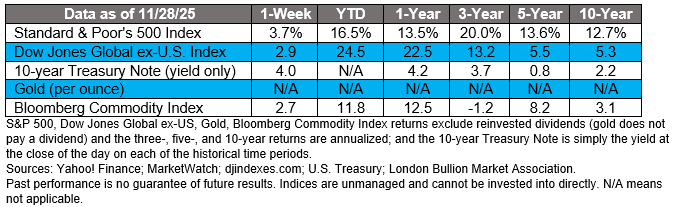
Stock markets in the United States reversed course last week, with two major indices eking out gains for the month, reported Callum Keown of Barron’s. There were some other important changes last week that also may affect markets and investors. Here’s a recap:
New expectations for rate cuts. Stock markets gained as the probability that the Federal Reserve (Fed) will lower the federal funds rate in December increased from 30 percent on November 19 to above 85 percent last week.
“The shift in rate sentiment started after last week’s delayed September jobs data, which painted a mixed picture. It then picked up steam on Friday after New York Fed President John Williams signaled he sees room for a reduction ‘in the near term’ amid labor market softness,” reported Edward Bolingbroke and Ye Xie of Bloomberg.
Signs of weakness in the housing market. The move from a seller’s housing market to a buyer’s housing market may have begun, reported Prashant Gopal of Bloomberg. In September, price growth slowed for the eighth month in a row as demand for homes fell amid economic uncertainty and affordability issues.
“Homesellers in the U.S. are yanking listings off the market, as the nation’s real estate sector stagnates. Nearly 85,000 sellers removed their properties in September, the highest number for that month in eight years, according to Redfin. The number of stale listings — those sitting on the market for 60 days or more — jumped to the highest level for any September since 2019.”
An unanticipated credit risk for lenders. A Supreme Court decision legalized state-level sports gambling in 2018 and it’s affecting credit scores in states where online sports gambling is allowed, according to research from UCLA. Deteriorating consumer financial health could lead to problems for lenders. Nick Devor of Barron’s cited analysts at Bank of America who wrote:
“For lenders the increasing availability of online betting markets raises the potential for revolving debt spikes, accelerated defaults, and higher charge-off rates, particularly among subprime borrowers…a new risk for lenders, one that they have not had to deal with historically and underwriting models may need to be adapted.”
Stock markets in the United States moved higher over the shortened holiday week, “ending a volatile November and [capping] off a strong Thanksgiving week,” reported Barron’s. “In a remarkable comeback, the Dow closed 0.3 [percent] higher for November. It was down 3.8 [percent] just eight days ago.” Yields on U.S. Treasuries were mixed.
This Is Your Brain On Technology
Pocket computers are mighty helpful. Smartphones let us make phone calls, listen to music, debunk mistaken information, conduct banking transactions, and do a lot more! It’s a fact that people spend a lot of time on their phones.
“According to recent data, the average person spends 4 hours and 37 minutes on their phone every day. That's the equivalent of over 1 day per week or 6 days per month. Across a year, that's approximately 70 days spent looking at a phone…On average, people check their phones 58 times per day,” reported Fabio Duarte on Exploding Topics.
While smartphones are convenient and make life easier, they may hurt our ability to concentrate and pay attention, according to a paper published in Scientific Reports. Researchers asked 20– to 34-year-olds to complete a test. Those who were tested without their phones present worked faster and had significantly better performance than participants who were tested with their phones in the room.
“[The study] provides evidence that even the mere presence of one’s smartphone consumes cognitive resources, without willingly shifting attention or actively using the smartphone. In the test situation, there was no visible interaction with the smartphone, as the smartphone was not looked at or picked up.”
No matter what type of device people are using, too much screen time can affect brain health. A recent study found that too much screen time can thin “the cerebral cortex, the brain’s outermost layer responsible for processing memory and cognitive functions, such as decision-making and problem-solving,” reported Mary Grace Descourouez in Stanford Lifestyle Medicine. In addition, “Light from the screen can delay melatonin release from the brain’s pineal gland, impacting the body’s natural circadian rhythm and causing difficulty sleeping.”
With smartphones, as with so many things, moderation is a virtue.
Weekly Inspiration
“What is the world’s biggest city? To an alien gazing down from space, ignoring political boundaries and just mapping contiguous areas of high population density, the answer would be clear: the Pearl River Delta, a chain of southern Chinese cities that have fused into one vast sprawl. Its population is projected to reach 73m people in 2026, just as a regional high-speed railway network, to bind it together, is due to be completed.”
-- The Economist, The World Ahead, Mapping 2026
Best Regards,
California Retirement Advisors