
Weak Hiring Should Have Pulled Rates Down Last Week. Only the Short-Term Ones Fell
Weak hiring is supposed to be good news for bonds. When the job market cools, the Fed has less reason to raise rates, and yields tend to drift lower. Last week the first half of that held. The second half did not.
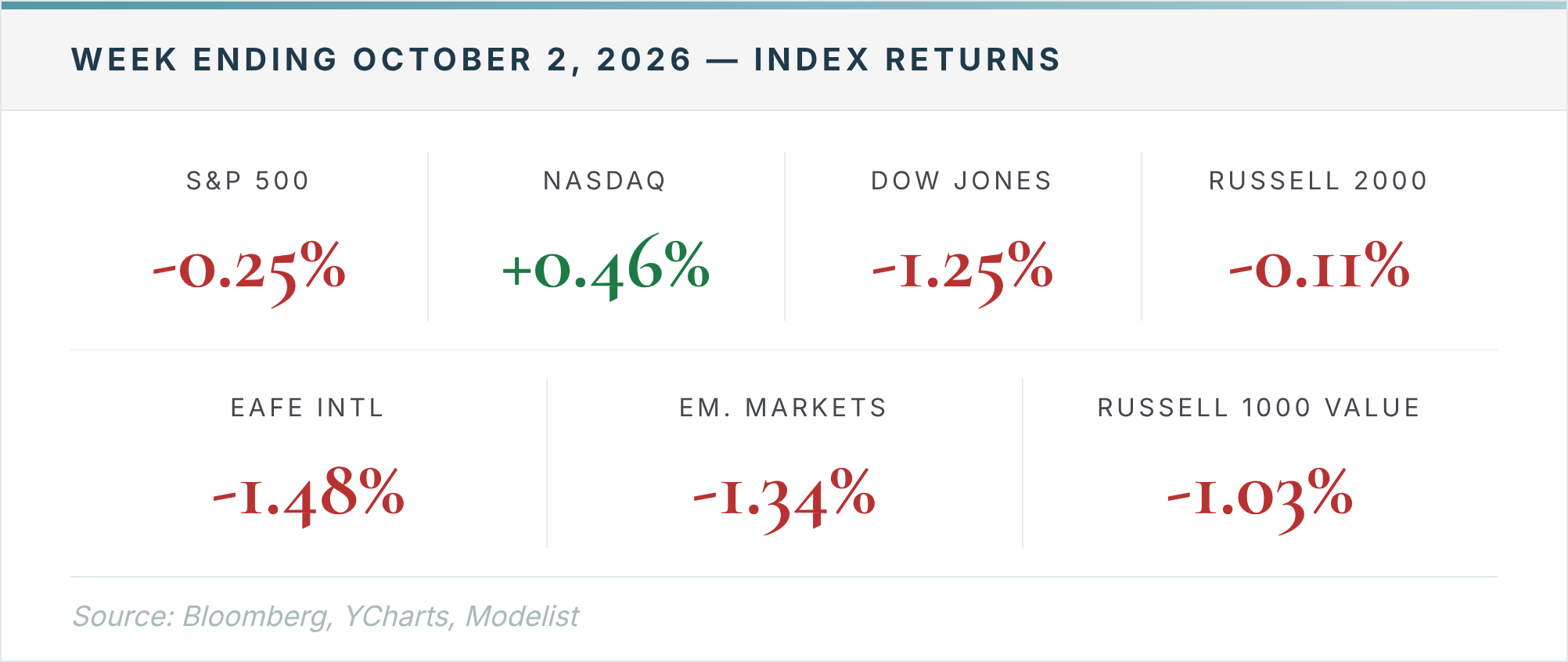
September payrolls rose by 29,000 against a forecast of 90,000, the prior two months were revised down by a combined 60,000, and unemployment ticked up to 4.2%. Core PCE, the Fed's preferred inflation gauge, rose 0.2% in August, bringing the annual rate to 3.0%. One month after the Fed raised rates in September, that combination gives policymakers room to wait. Stocks split on the news. The NASDAQ gained 0.46%, the S&P 500 slipped 0.25%, and the Dow fell 1.25%.
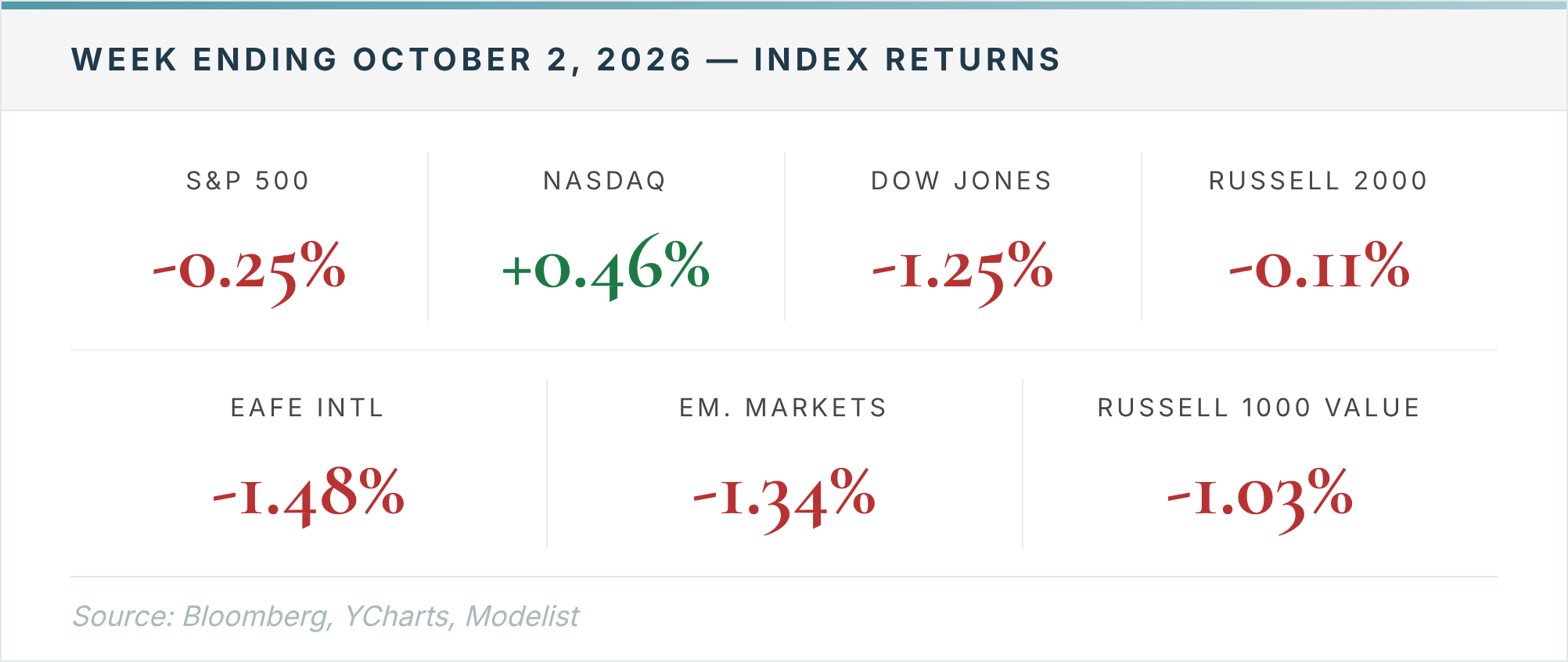
For the second week in a row, technology led while long-term rates rose, which runs against the usual story that expensive growth stocks suffer most when yields climb. Information Technology gained 1.45%. The sectors usually described as defensive did little defending: Health Care fell 2.70% and Consumer Staples 1.81%. Financials, whose lending margins tend to widen when long rates rise faster than short ones, fell 2.48% in exactly that kind of week.
The Fed Moved the Short End. Something Else Moved the Long End.
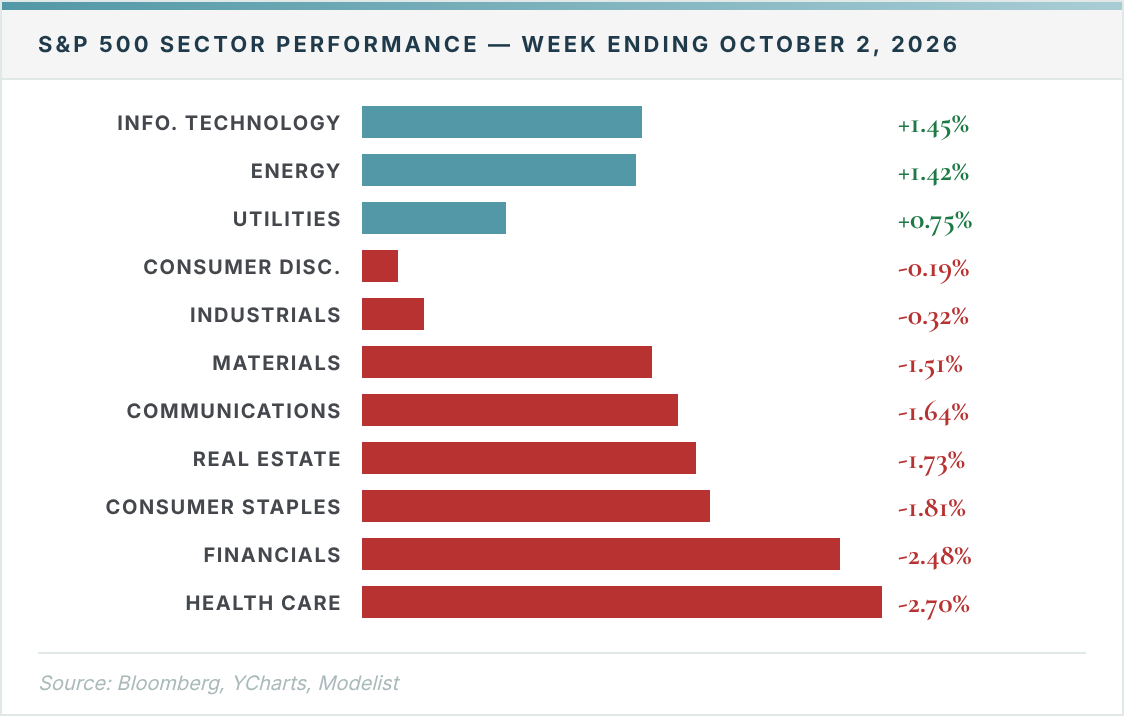
The 2-year Treasury yield tracks what markets expect from the Fed over the next two years. It fell 3 basis points to 4.82% as expectations of another hike eased. On the same news, the 10-year yield rose 11 basis points to 5.27% and the 30-year rose 13 basis points to 5.62%.
Long-term yields price more than the Fed. They carry what investors expect inflation to average over a decade or more, how much the Treasury needs to borrow, and how much extra return lenders demand for committing money that long. A slower September for hiring improved none of those. The Bloomberg U.S. Aggregate bond index fell 0.60% for the week.
The split matters because of how bond prices respond. A bond's price moves opposite its yield, and the further away its maturity, the larger that move. A two-year note barely registers a few basis points. A bond with twenty or thirty years left absorbs the full weight of a week when long yields rise 11 to 13 basis points, and that is where most of the price risk in a bond allocation sits.
In our previous commentary we wrote that rising rates were landing on the income side of portfolios rather than on tech. Last week adds a complication. The relief many people expect from a Fed that stops raising rates did arrive, and it reached only the shortest bonds. Anyone whose plan counts on longer-term bond prices recovering once the Fed pauses is relying on the long end of the curve to follow the short end. Last week it went the other way.
Want the Full Picture?
The complete Market Insights Weekly report for the week ending October 2, 2026, including equity style, sector, and fixed income data across multiple time periods, is available as a PDF. View the full report
What This Means for Your Retirement Plan
A retiree drawing income doesn't need to know which way the 10-year yield moves next. What matters is that the money for the next few years of spending sits somewhere a week like this one can't reach. That is the mechanism behind The Bucket Plan®: assets are segmented by when they will be needed, and the risk in each segment is set to match. Near-term income is held in short-maturity holdings, the part of the curve where yields eased last week. Longer-term money carries the interest-rate exposure, because it has years to absorb a move like last week's before any of it has to be sold.
If last week left you unsure which part of your portfolio pays for the next few years of retirement and which part is exposed to the 30-year bond market, that is worth knowing before the next jobs report rather than after it. We would be glad to walk through how that structure would look for your situation.
Schedule a 20-Minute Due-Diligence Q&A