
facebook twitter instagram linkedin google youtube vimeo tumblr yelp rss email podcast phone blog search brokercheck brokercheck Play Pause
What's the Difference Between Generative AI and Agentic AI? Thumbnail

What's the Difference Between Generative AI and Agentic AI?

The Markets

The interest rate outlook shifted.

Last week, central banks around the globe met to set policy rates. While most chose to leave rates unchanged, many expressed concern about the potential economic consequences of the War in Iran, reported Holly Ellyatt of CNBC. 

“Central bankers in Japan, Indonesia and Taiwan opted to stay on the sidelines, as did their counterparts in the U.S., Canada, the U.K. and Europe. The notable exception was Australia, where policymakers narrowly voted to raise rates…,” reported Jihye Lee and Fabiana Negrin Ochoa in Morningstar News.

The Federal Reserve held rates steady 

In the United States, the Federal Open Market Committee (FOMC), which is the Federal Reserve’s (Fed’s) rate-setting body, kept the federal funds rate unchanged. In addition, the FOMC summary of economic projections indicated Fed officials expect to see faster economic growth and higher inflation in 2026. Nicole Goodkind of Barron’s described the Fed’s current challenge: 

“One rate cut technically remains on the table this year. But the bar to deliver it is higher. The Fed is caught between an inflation overshoot it can’t dismiss, an oil shock it can’t predict, a labor market on a knife’s edge, and a leadership transition tangled in legal uncertainty,” reported Goodkind.

At the post-meeting press conference, Fed Chair Jerome Powell indicated he plans to remain on the Fed board until a new Chair is confirmed and the current investigation of the Fed by the Department of Justice is finished.

Investor optimism faded

Investors considered the actions and rhetoric of global central banks and seemed to settle on the idea that policy rates could move higher this year. In response, bond yields began to rise.

“Global bond markets extended one of their biggest selloffs in a year on Friday, taking benchmark Treasury bonds sharply higher and weighing on stocks in markets around the world, with investors ripping up bets on central bank interest rate cuts as war in the Middle East shows no signs of ending,” reported Martin Baccardax of Barron’s.

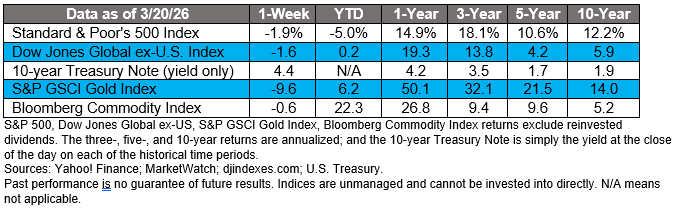
Last week, major U.S. stock indexes moved lower, while yields on most maturities of U.S. Treasuries moved higher.


What's the Difference Between Generative AI and Agentic AI?

Many Americans rely on artificial intelligence (AI) tools every day, sometimes without realizing they’re doing so. Voice-activated home assistants, for example, are useful for checking the weather, setting reminders, or listening to music. Voice assistants are just one form of AI. Over the past few years, two more powerful approaches have emerged that are reshaping how we work: generative (gen) AI and agentic AI.

Gen AI: Responds to prompts

Gen AI chatbots have become widely available. This type of AI is reactive and task-oriented, helping people conduct research, draft emails, create images, write music, and code websites, reported Adam Zewe of MIT News. Gen AI systems: 

  • Recognize patterns and rely on that knowledge to predict what comes next. 
  • Respond to user prompts, which affect the quality of output.

One drawback is that AI chatbots can hallucinate, meaning they confidently generate inaccurate answers. When using gen AI, human guidance and oversight are required to ensure the quality of the end product.

AI agent: Acts on its own

Last year, agentic AI became more prevalent. Agentic AI systems are partially or fully autonomous, meaning they perceive, reason, and act without human supervision, according to Beth Stackpole of MIT’s Ideas Made to Matter. AI agents are:

  • Integrated with software systems to complete complex tasks independently, and
  • Contained by robust strategy and risk management frameworks.

There are risks and challenges to agentic AI. Stackpole cautioned that organizations implementing these tools may find them to be unreliable or prone to unethical behavior. There are also cybersecurity and accountability issues.

What do we want AI to do?

Recently, Bloomberg’s Sommer Saadi and Stephanie Flanders spoke with Nobel Prize–winning economist Daron Acemoglu, who believes that “the greatest economic benefits would come from ‘pro-worker AI’ that enhances human capabilities, enabling workers to perform more complex and valuable tasks. But current business incentives, market structures and policy frameworks favor labor replacement.”

As AI continues to evolve, the stakes of getting it right are becoming considerably higher. The question is no longer how AI can help us work smarter; it's how we ensure these tools serve people. Whether the future belongs to pro-worker AI or labor-replacing automation will depend less on the technology and more on the choices organizations, policymakers, and workers make today.


Weekly Inspiration

“Even the darkest night will end and the sun will rise.”

― Victor Hugo, Author

Best Regards,
California Retirement Advisors


Investment advisory services offered through Mutual Advisors, LLC DBA California Retirement Advisors, a SEC registered investment advisor. Securities offered through Mutual Securities, Inc., member FINRA/SIPC. Mutual Securities, Inc. and Mutual Advisors, LLC are affiliated companies. CA Insurance license #0B09076. This content is developed from sources believed to be providing accurate information and provided by California Retirement Advisors. It may not be used for the purpose of avoiding any federal tax penalties. Please consult legal or tax professionals for specific information regarding your individual situation. The opinions expressed and material provided are for general information and should not be considered a solicitation for the purchase or sale of any security. California Retirement Advisors, nor any of its members, are tax accountants or legal attorneys and do not provide tax or legal advice. For tax or legal advice, you should consult your tax or legal professional.
The information being provided is strictly as a courtesy. When you click on any of the links provided here, you are leaving this website and viewing information provided by a third party. We make no representation as to the completeness or accuracy of information provided by any third-party website. Nor is the company liable for any direct or indirect technical or system issues or any consequences arising out of your access to, or your use of third-party technologies, websites, information and programs made available through this website. By accessing these calculators, you assume total responsibility and risk for your use of the third-party website.
 * These views are those of Carson Coaching, not the presenting Representative, the Representative’s Broker/Dealer, or Registered Investment Advisor, and should not be construed as investment advice.
* Government bonds and Treasury Bills are guaranteed by the U.S. government as to the timely payment of principal and interest and, if held to maturity, offer a fixed rate of return and fixed principal value.  However, the value of fund shares is not guaranteed and will fluctuate.
* Corporate bonds are considered higher risk than government bonds but normally offer a higher yield and are subject to market, interest rate and credit risk as well as additional risks based on the quality of issuer coupon rate, price, yield, maturity, and redemption features.
* The Standard & Poor's 500 (S&P 500) is an unmanaged group of securities considered to be representative of the stock market in general. You cannot invest directly in this index.
* All indexes referenced are unmanaged. The volatility of indexes could be materially different from that of a client’s portfolio. Unmanaged index returns do not reflect fees, expenses, or sales charges. Index performance is not indicative of the performance of any investment. You cannot invest directly in an index.
* The Dow Jones Global ex-U.S. Index covers approximately 95% of the market capitalization of the 45 developed and emerging countries included in the Index.
* The 10-year Treasury Note represents debt owed by the United States Treasury to the public. Since the U.S. Government is seen as a risk-free borrower, investors use the 10-year Treasury Note as a benchmark for the long-term bond market.
* Gold represents the 3:00 p.m. (London time) gold price as reported by the London Bullion Market Association and is expressed in U.S. Dollars per fine troy ounce. The source for gold data is Federal Reserve Bank of St. Louis (FRED), https://fred.stlouisfed.org/series/GOLDPMGBD228NLBM.
* The Bloomberg Commodity Index is designed to be a highly liquid and diversified benchmark for the commodity futures market. The Index is composed of futures contracts on 19 physical commodities and was launched on July 14, 1998.
* The DJ Equity All REIT Total Return Index measures the total return performance of the equity subcategory of the Real Estate Investment Trust (REIT) industry as calculated by Dow Jones.
* The Dow Jones Industrial Average (DJIA), commonly known as “The Dow,” is an index representing 30 stock of companies maintained and reviewed by the editors of The Wall Street Journal.
* The NASDAQ Composite is an unmanaged index of securities traded on the NASDAQ system.
* International investing involves special risks such as currency fluctuation and political instability and may not be suitable for all investors. These risks are often heightened for investments in emerging markets.
* Yahoo! Finance is the source for any reference to the performance of an index between two specific periods.
* The risk of loss in trading commodities and futures can be substantial. You should therefore carefully consider whether such trading is suitable for you in light of your financial condition. The high degree of leverage is often obtainable in commodity trading and can work against you as well as for you. The use of leverage can lead to large losses as well as gains.
* Opinions expressed are subject to change without notice and are not intended as investment advice or to predict future performance.
* Economic forecasts set forth may not develop as predicted and there can be no guarantee that strategies promoted will be successful.
* Past performance does not guarantee future results. Investing involves risk, including loss of principal.
* The foregoing information has been obtained from sources considered to be reliable, but we do not guarantee it is accurate or complete.
* There is no guarantee a diversified portfolio will enhance overall returns or outperform a non-diversified portfolio. Diversification does not protect against market risk.
* Asset allocation does not ensure a profit or protect against a loss.
* Consult your financial professional before making any investment decision.
Sources: 
https://www.cnbc.com/2026/03/19/ecb-boe-swiss-national-bank-riksbank-interest-rate-decisions.html
https://www.morningstar.com/news/dow-jones/202603202272/asian-central-banks-shift-to-sidelines-as-mideast-conflict-drags-on
https://www.barrons.com/articles/powell-federal-reserve-interest-rates-e5af6407? or go to https://resources.carsongroup.com/hubfs/WMC-Source/2026/03-23-26-Barrons-Higher-Oil-Higher-Inflation%20-%203.pdf
https://www.federalreserve.gov/monetarypolicy/files/fomcprojtabl20260318.pdf
https://www.federalreserve.gov/mediacenter/files/FOMCpresconf20260318.pdf [Transcript]
https://www.barrons.com/articles/treasuries-extend-slump-likelihood-of-fed-rate-cuts-fades-610329a2? or go to https://resources.carsongroup.com/hubfs/WMC-Source/2026/03-23-26-Barrons-Treasuries-Extend-Slump%20-%206.pdf
https://www.barrons.com/market-data?mod=BOL_TOPNAV or go to https://resources.carsongroup.com/hubfs/WMC-Source/2026/03-23-26-Barrons-DJIA-S&P-Nasdaq%20-%207.pdf
https://home.treasury.gov/resource-center/data-chart-center/interest-rates/TextView?type=daily_treasury_yield_curve&field_tdr_date_value=202603
https://news.mit.edu/2023/explained-generative-ai-1109
https://mitsloan.mit.edu/ideas-made-to-matter/agentic-ai-explained
https://www.bloomberg.com/news/articles/2026-03-18/podcast-ai-is-being-built-to-replace-you-not-help-you or go to https://resources.carsongroup.com/hubfs/WMC-Source/2026/03-23-26-Bloomberg-AI-Is-Being-Built-to-Replace-You%2011.pdf
https://www.goodreads.com/work/quotes/3208463-les-mis-rables