
Your Account Fell Last Week. Gold Rose $227. Only One of Those Should Concern You.
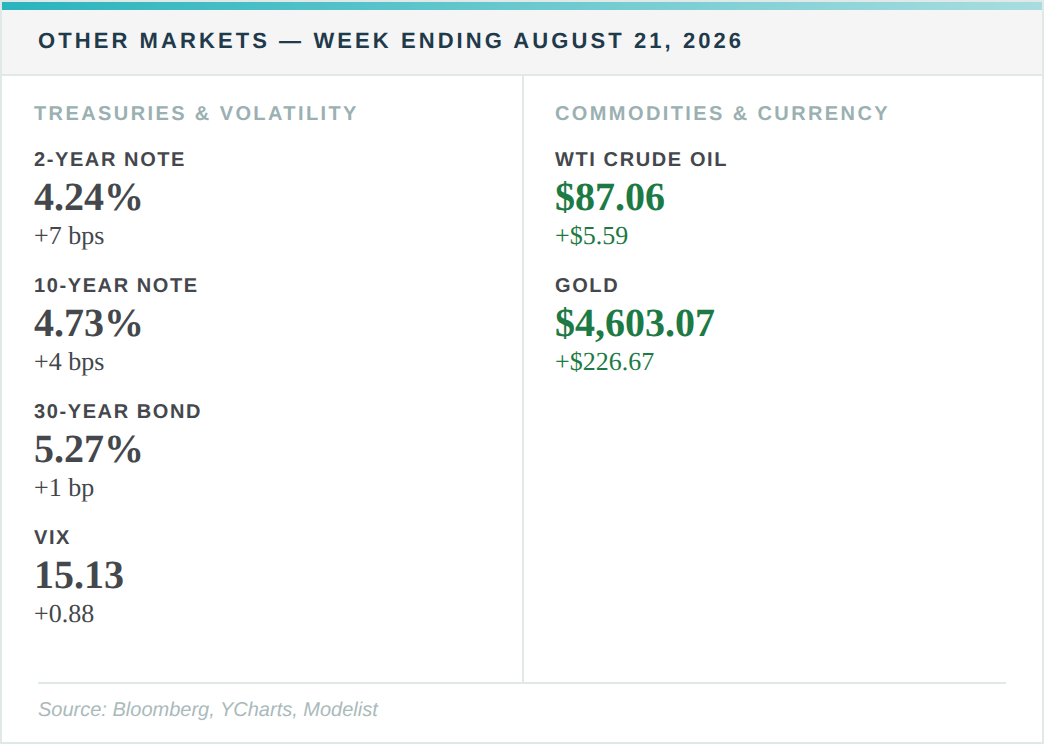
Gold gained $226.67 an ounce last week. Crude added $5.59 a barrel. Both of those happened while the 30-year Treasury yield moved a single basis point, which rules out the explanation most people will reach for.
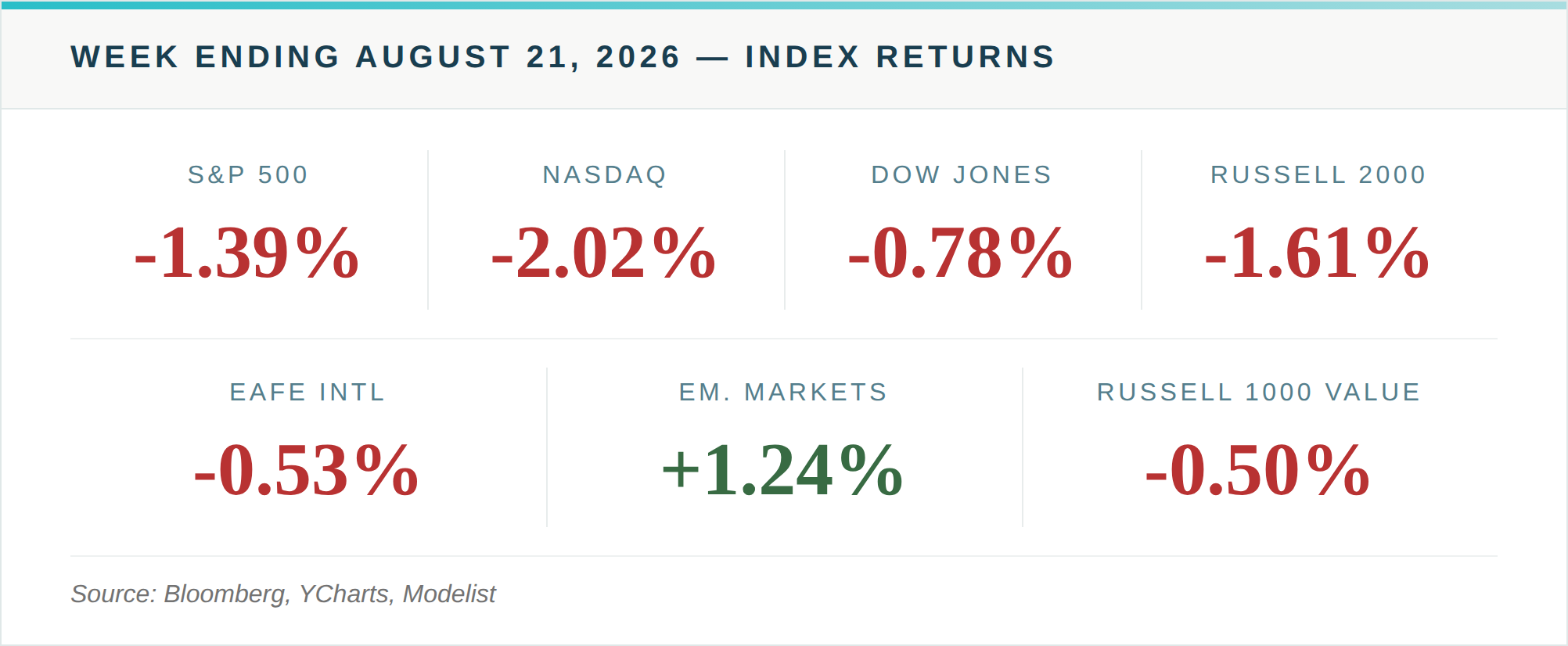
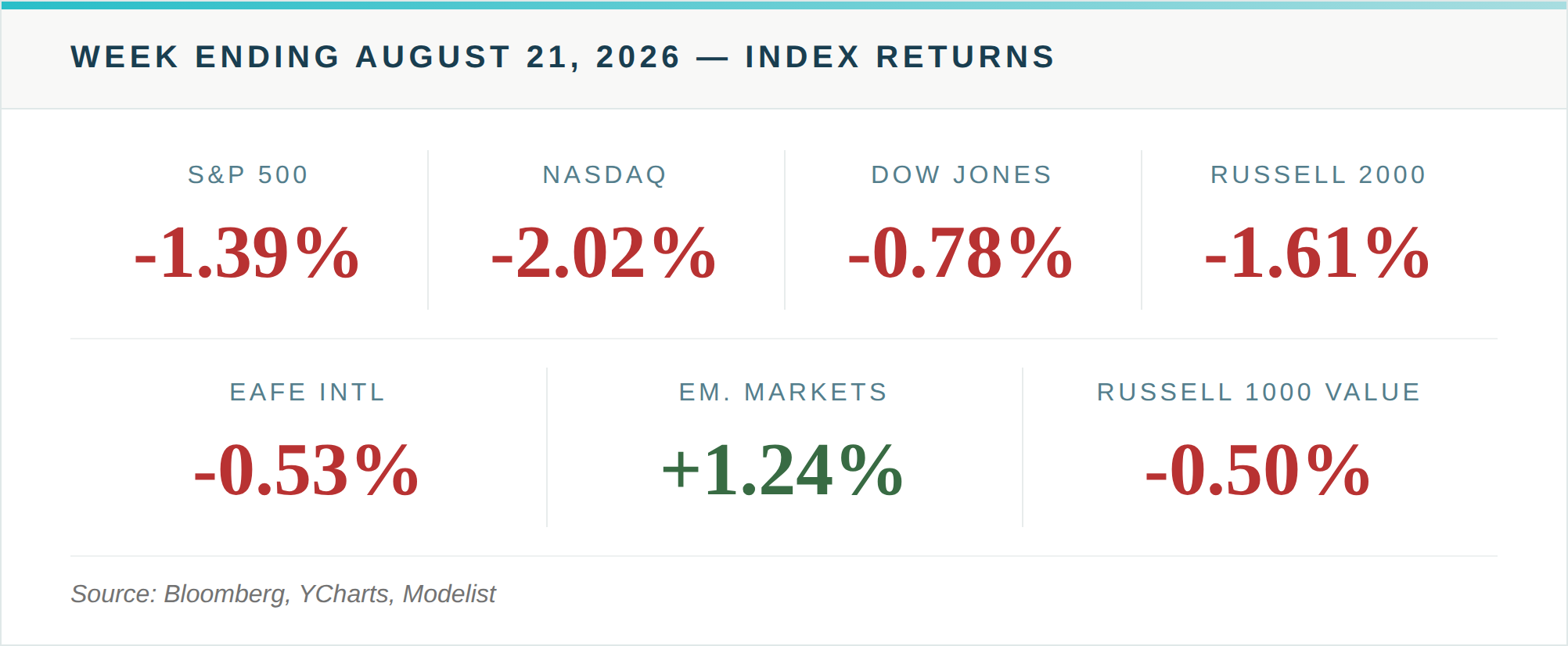
The easy version of last week is already written. Concerns about federal spending and renewed tension in the Middle East pushed US stocks lower, and the damage was broad: the S&P 500 fell 1.39%, the NASDAQ 2.02%, the Dow 0.78%, and the Russell 2000 1.61%. Nothing about that account is wrong. It just isn't the interesting part.
If fiscal worry were the engine of last week, it would show up first at the long end of the Treasury curve. That is the part of the market that prices the government's borrowing over decades, and it is where deficit anxiety has to register before it registers anywhere else. It didn't. The 30-year closed at 5.27%, up one basis point. The 10-year finished at 4.73%, up four. The largest move on the curve was at the front, where the 2-year added seven basis points to 4.24% — the opposite shape of a deficit story.
That matters for what happened underneath the index. Utilities finished last among the eleven S&P 500 sectors at -3.49%, with Industrials at -3.37% and Information Technology at -3.18% just ahead of it. For three weeks running, this column has traced weakness in income-oriented sectors back to long rates. Last week that explanation was not available. Utilities lost three and a half percent in a week when the long bond effectively did not move.
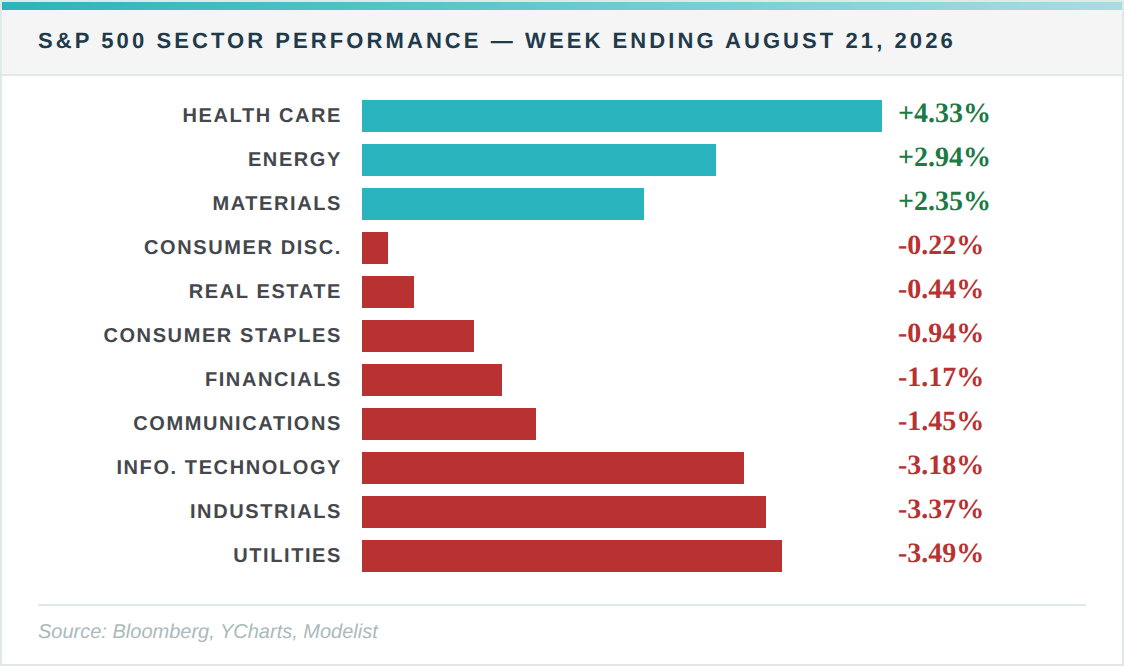
So look at what did move. Gold rose 5.2% on the week. Crude rose 6.9%. The two best sectors on the board were Health Care at +4.33% and Energy at +2.94%. Emerging markets gained 1.24% while the S&P 500 fell. That combination does not describe a market worried about growth. A growth scare sells energy first and emerging markets second. This one bought both.
What last week actually repriced was the purchasing power of a dollar, not the earnings power of American companies. Hard assets bid up, energy bid up, non-dollar equity markets bid up, and the equity index that everyone watches went down while the bond market that everyone blames sat still.
For someone drawing income from a portfolio, that distinction is the whole ballgame. A drawdown announces itself. You open the statement, the number is smaller, and you feel it. Purchasing power erosion never announces itself. The balance can hold perfectly steady for years while the grocery bill, the property tax, the Medicare premium, and the contractor's estimate all quietly climb past it. One of those risks is visible and temporary. The other is invisible and permanent.
This week gives the market a chance to confirm or reject its own read. PCE lands Wednesday, and it is the cleanest look at household income, spending, and inflation on the calendar. If the data lines up with what gold and crude priced last week, the move was a signal. If it doesn't, last week was positioning rather than information.
Want the Full Picture?
For the complete index returns, all 11 sector breakdowns, treasury yields, and commodities data, view the full report below. View Full Weekly Market Report →
What This Means for Your Retirement Plan
A plan built only to survive a falling account balance is defending against half the risk. Last week is a reasonably clean illustration of the other half: the index dropped, and the assets that hold their value when a dollar buys less went up sharply. A retiree who is thirty years from the end of the plan will be tested far more by the second problem than by the first. That is the reason The Bucket Plan® separates the money you spend in the next few years from the money that has to keep growing for the next few decades. The near-term money is supposed to be stable and boring. The long-term money exists precisely so that a week like last week is working for you somewhere in the portfolio rather than only against you.
If your portfolio is built around a single question — how much did it go up or down — a week like this one is hard to read, because the answer was "down" while several of the things a retirement plan actually depends on went up. That gap is worth a conversation.
Schedule a 20-Minute Due-Diligence Q&A Call →