
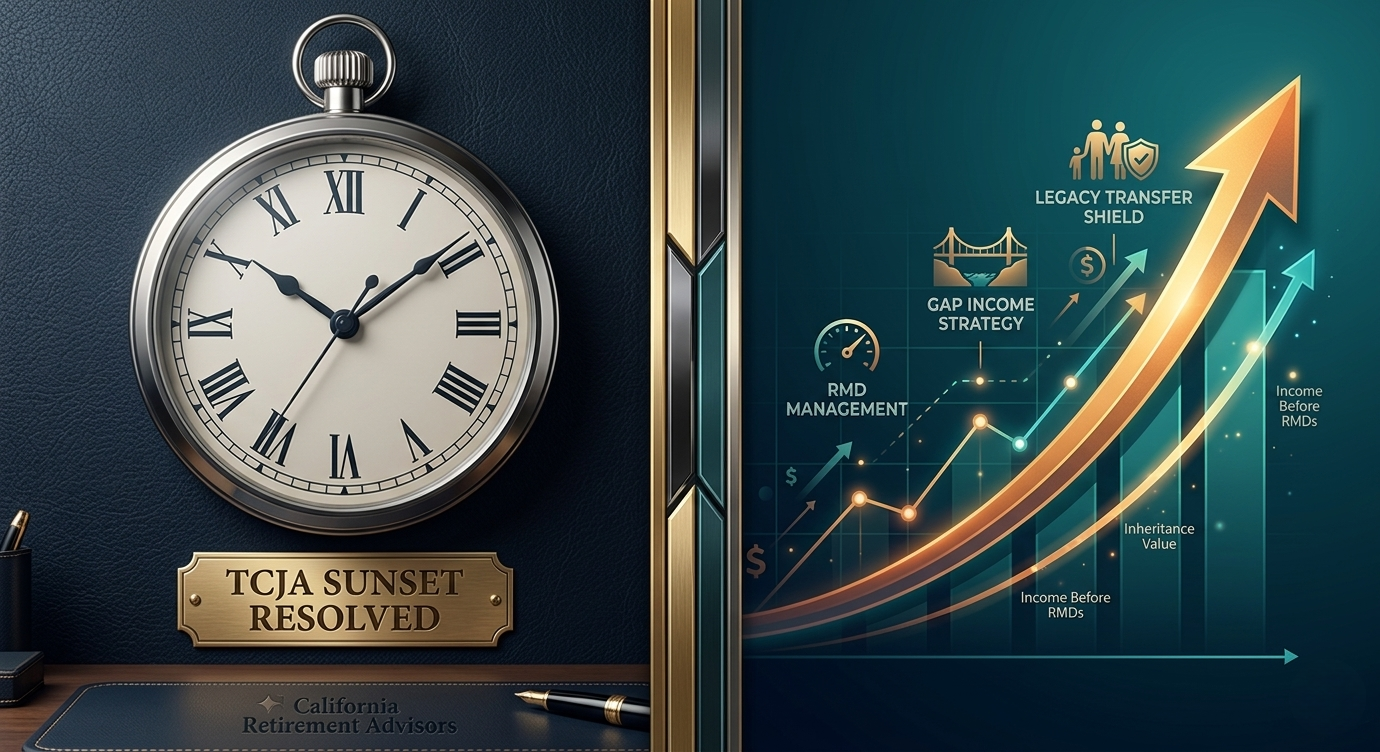
The Roth Conversion Deadline Died. The Reason to Convert Didn't.
For years, the urgency around Roth conversions came from the same place — a built-in expiration date on the 2017 tax cuts that was going to push rates higher the moment Congress let it happen. The brackets were favorable but temporary. Every year you waited was a year closer to the cliff.
Then Congress removed the cliff. The One Big Beautiful Bill Act, signed July 4, 2025, made most TCJA provisions permanent. The rates didn't reset. The urgency that drove a decade of Roth conversion conversations — gone.
And with it, for a lot of people, went the motivation to act.
That's the mistake.
The Deadline Was Never the Real Reason
The legislative clock was a convenient forcing function. But the actual case for converting a traditional IRA to a Roth was never really about what Congress might do. It was about what your tax situation will look like at 73 — when the IRS starts requiring you to take money out whether you need it or not.
That math hasn't changed.
What Is a Roth Conversion?
A Roth conversion moves pre-tax dollars from a traditional IRA into a Roth IRA. You pay ordinary income tax on the amount converted in that year. In exchange, the money grows tax-free, comes out tax-free in retirement, and is never subject to required minimum distributions.
The tradeoff makes sense when the rate you pay today is lower than the rate you'd face later. For most pre-retirees with significant traditional IRA balances, it still is — just for reasons that have nothing to do with a sunset date.
Why the Case Still Holds
1. The gap before your RMDs may be the lowest-income years you'll ever have.
If you've retired but aren't yet drawing Social Security, and your required minimum distributions don't begin until 73, there's often a window — sometimes a decade — where your taxable income is lower than it's been in 30 years. Converting during that gap means paying tax at a rate that reflects reduced income, not peak-career earnings or forced distributions stacked on top of everything else.
2. A large traditional IRA is a tax liability your heirs don't know they're inheriting.
Every dollar that stays in a traditional IRA will eventually be taxed as ordinary income — by you through RMDs, or by whoever inherits it. Under current law, most non-spouse beneficiaries must empty an inherited IRA within 10 years of the owner's death. For an adult child still in their earning years, those distributions land on top of a salary and push them into a higher bracket. Converting now — even partially — reduces the tax burden your family will be forced to absorb.
3. RMDs compound the problem the longer you wait.
Required minimum distributions are calculated as a percentage of your account balance each year. The larger your traditional IRA grows, the larger the forced distribution — and the less control you have over the outcome. Converting in measured amounts before RMDs begin keeps the balance lower, keeps the forced distributions smaller, and keeps more of the decision in your hands.
4. Roth accounts have no required minimum distributions.
A Roth IRA can stay invested, compounding tax-free, for as long as you live — and pass to your heirs without a required distribution schedule attached to it. For someone who doesn't need the funds for income, that flexibility has real dollar value that a traditional IRA simply can't match.
What Most People Get Wrong
Using the deadline's disappearance as permission to wait. The cliff gave people a reason to act. Now that it's gone, the default is inaction — and inaction is a decision with consequences that compound quietly for years before they become obvious.
Converting too much in one year. A large conversion spikes taxable income, can trigger higher Medicare premiums, and may push you past the bracket where converting still makes sense. The goal is to convert up to — not past — the top of your current bracket, and revisit it every year.
Treating it as a one-time decision. The right conversion amount changes annually based on your income, Social Security timing, projected RMDs, and estate picture. It's a planning exercise, not a transaction.
What To Do
The deadline is gone. The problem it was pointing at isn't. If you have a significant traditional IRA and you're approaching the window before RMDs begin, the case for converting is still worth working through — probably more clearly now that it isn't being driven by a countdown.
Our 20-Minute Due-Diligence Q&A Call is a good place to start. We'll look at your current bracket, your projected RMD trajectory, and whether a partial conversion makes sense for your situation this year.
Schedule your 20-Minute Due-Diligence Conversation →