
Your QCD Timing Might Be Off — And It Could Cost You a Tax Break
The Advice Is Well-Meaning. But It Isn't Quite Right.
If you've ever looked into qualified charitable distributions, you've probably heard some version of the same guidance: do your QCD before your RMD. It sounds sensible. It implies a sequence — first the charitable gift, then the required withdrawal. And for many people, it creates a quiet confidence that they know how this works.
That confidence is worth examining.
This post covers how the QCD and RMD actually interact for IRA owners who are 70½ or older, why the standard timing advice can be misleading, and what getting this right actually looks like — especially for those with large IRAs who are already managing significant tax exposure in retirement.
What a QCD Actually Is
The tax advantage is significant: the amount transferred is excluded from your income entirely. For a retiree in a high-tax state like California, that exclusion can be worth far more than a standard charitable deduction — particularly for those who no longer itemize.
The QCD is not a deduction. It is an exclusion. The dollars never enter your taxable income in the first place.
Where the Confusion Starts
Once a person turns 73, required minimum distributions begin. The IRS has allowed these funds to grow tax-deferred for decades — and now, annually, a portion must come out and be taxed. For people who don't need the income, it can feel like an unwelcome obligation.
The QCD offers an elegant solution: if your RMD funds are going to be distributed anyway, direct them to charity and eliminate the tax entirely. No taxable income. No tax bill on those dollars. Ever.
The timing advice — "do your QCD before your RMD" — exists to protect this opportunity. And the instinct behind it is correct. Once you take a normal, non-charitable distribution, that money is taxable. A QCD made afterward cannot reverse that.
But here's where the advice gets imprecise: it implies that a QCD and an RMD are two separate transactions done in a particular order. For most people who are trying to offset their RMD with a charitable gift, that framing doesn't reflect how it actually works.
One Transaction. Two Results.
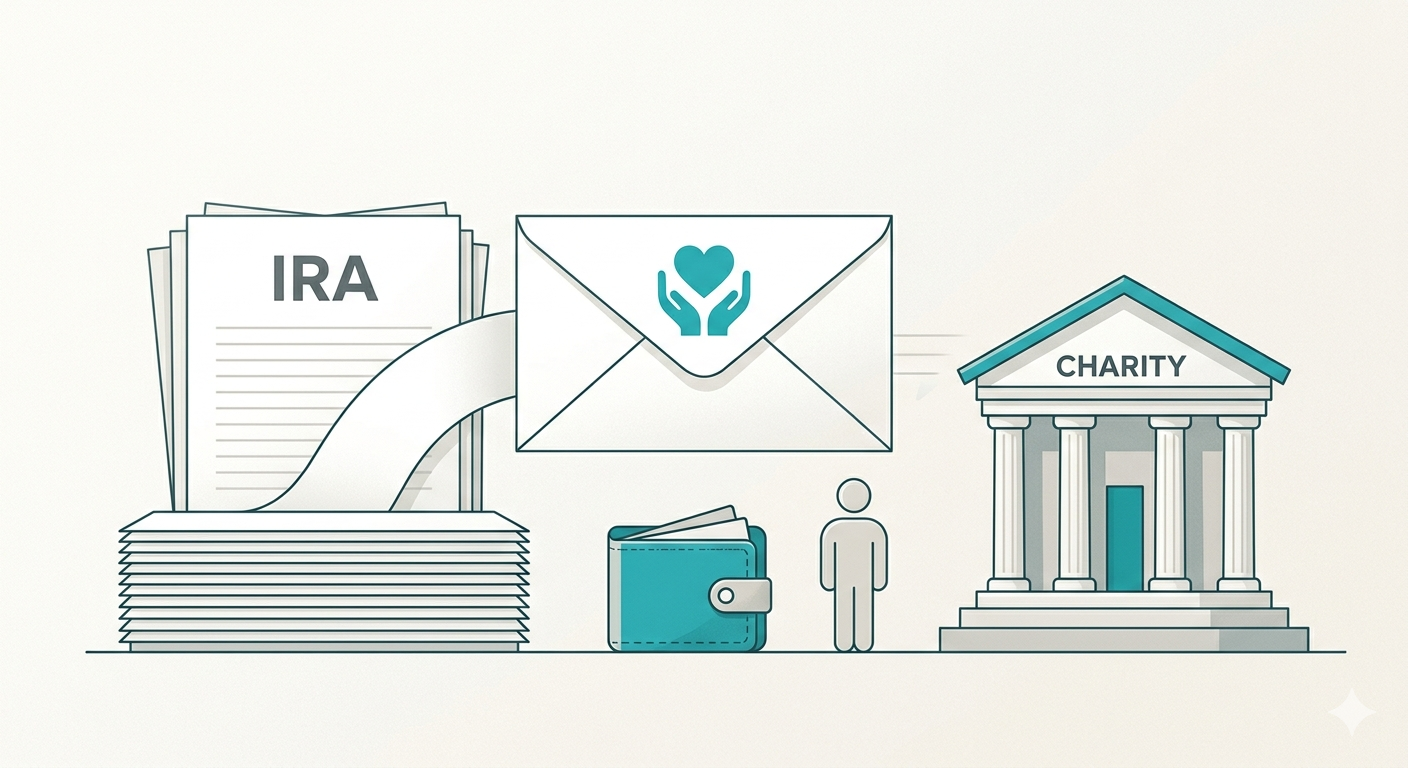
When you direct your IRA custodian to send a distribution directly to a qualifying charity, you are not doing a QCD and then an RMD. You are doing one transaction that accomplishes both simultaneously.
Consider a straightforward example. A 75-year-old has an IRA with a $10,000 required minimum distribution for the year. Rather than receiving that $10,000 and including it in taxable income, she calls her IRA custodian and requests a $10,000 QCD to her chosen charity. The custodian sends the check directly. In that single transaction, her RMD for the year is satisfied — and because it was processed as a QCD, none of it is included in her taxable income.
There is no prior QCD and a later RMD. There is no offsetting of one against the other. There is one distribution that is, at the same moment, both a QCD and an RMD.
The practical implication: the sequencing language only matters as a warning against the wrong move. Take your RMD as a normal distribution first, and that income is already locked in — no later charitable gift can undo it. The message isn't really about order. It's about method.
What To Do
If charitable giving is already part of how you think about your retirement, and you are subject to required minimum distributions, a few things are worth confirming with your advisor.
First, has the QCD been coordinated as part of your overall income picture for the year? For those with large IRAs, even a partial QCD — $30,000 or $50,000 directed to charity — can meaningfully reduce adjusted gross income, which affects Medicare premiums, the taxation of Social Security, and California state tax exposure in ways that ripple across the whole plan.
Second, is your IRA custodian clear on the mechanics? The distribution must be made directly to the charity. A check made out to you, even if you pass it along to a charity, does not qualify.
Third, is the QCD being treated as a standalone decision, or is it part of a coordinated strategy that accounts for your full income situation, your giving goals, and your long-term tax trajectory? The difference between a well-placed QCD and an afterthought can be significant — not just for this year, but for the years that follow.
A More Coordinated Approach
For existing CRA clients, your Tax Management Journey® is built to account for exactly these kinds of decisions. The interaction between RMD obligations, charitable intent, and California tax exposure is not a one-year question — it's a sequence that unfolds over time, and the earlier decisions shape the later ones. If you have questions about how your QCD fits into the current year's plan, your next review is the right place to start.
For those who are not yet working with CRA, this is one example of what coordinated planning actually looks like in practice. Not just knowing the rules — but knowing how they interact, in your specific situation, in a way that compounds over time. If that kind of approach sounds like what's been missing, we invite you to learn more.
Schedule a 20-Minute Due-Diligence Q&A Call →